Not every use of AI is Agentic Commerce
Agentic Commerce is currently the dominant topic. The term describes the next stage in the evolution of e-commerce. Autonomous AI agents act on behalf of consumers or businesses: They research products, compare prices, check availability, and handle the entire purchasing process – without requiring human approval at every step.
This changes who your target audience is.
Until now, humans were the buyers. They read product pages, looked at images, and compared descriptions. In Agentic Commerce, machines are increasingly making the initial selection. And a machine reads differently than a human.
It needs
- structured data
- complete attributes
- machine-readable information and
- clear system interfaces.
Anyone with gaps here will be overlooked – not because the product is bad, but because the agent cannot evaluate it. This also affects brand perception: An agent who can’t evaluate your product won’t recommend it – regardless of how strong the brand’s appeal is to human buyers.
The solution lies in AI systems that independently handle e-commerce tasks: enriching product data, adjusting prices, coordinating availability, and processing customer inquiries – without a human having to manually approve every step.
This is a reality. And it’s already working in production systems.
But it doesn’t work everywhere. And not simply because you integrate a new model.
An AI tool that generates text and is approved by an editor is not an agent. A chatbot is not autonomy. A stable pilot run on test data is a start, not proof.
The requirement runs deeper: in the data foundation and the architecture behind it.
What your system must be capable of before an AI agent can work within it
An AI agent that makes purchases on behalf of a buyer makes decisions based on the data it finds. Five requirements determine whether your system will be taken into account in this process.

API-first
Agents retrieve data and trigger processes. This is done programmatically. Slow integrations, batch exports, or manual intermediate steps hinder every productive agent, regardless of the model.
Every relevant system function must be accessible via a stable, documented API.
Structured data
An agent does not compare product images. It reads attributes, categories, and technical specifications.
Data that is not structured is not evaluated. Gaps in product data mean that the agent will select a fully described competitor product – not because it is better, but because it can be evaluated.
Product Experience Management (PXM) is not preparation for Agentic Commerce. PXM is the prerequisite for ensuring that your product range remains visible in Agentic Commerce.
Clear system boundaries
Which system is the source of truth? Who writes to which system? What happens when data from two sources conflicts?
When these questions remain unanswered, agents clash with existing processes. The result is an inconsistent data set and the need for manual corrections.
Governance is not an add-on. It is an integral part of the architecture.
Audit-ready processes
What decision did the agent make, and when? Why? What data was available? When an AI agent in your system triggers an order, applies a price change, or confirms availability, this must be traceable.
This is a requirement of internal quality assurance. It is also a requirement of the EU AI Act, which will be fully in effect starting in August 2026. Adding audit logs retroactively means doing the work twice.
Logging must be part of the system design from the very beginning.
Escalation paths
No agent works flawlessly. The question is, what happens when it is uncertain?
Defined escalation paths prevent incorrect decisions from proceeding unchecked through processes. They must be defined before go-live. For retailers and manufacturers, this means: You determine the threshold at which a human intervenes. This protects processes and builds trust in the system.
Human oversight is not a restriction on autonomy. It is the condition under which autonomy becomes justifiable.
Well-defined product types and an AI-capable platform – This is not a contradiction
Most companies already have part of the foundation in place. PIM systems, DAM solutions, and commerce platforms are available. The crucial question is whether they are AI-compatible – that is, whether an external agent can reliably access and work with them.
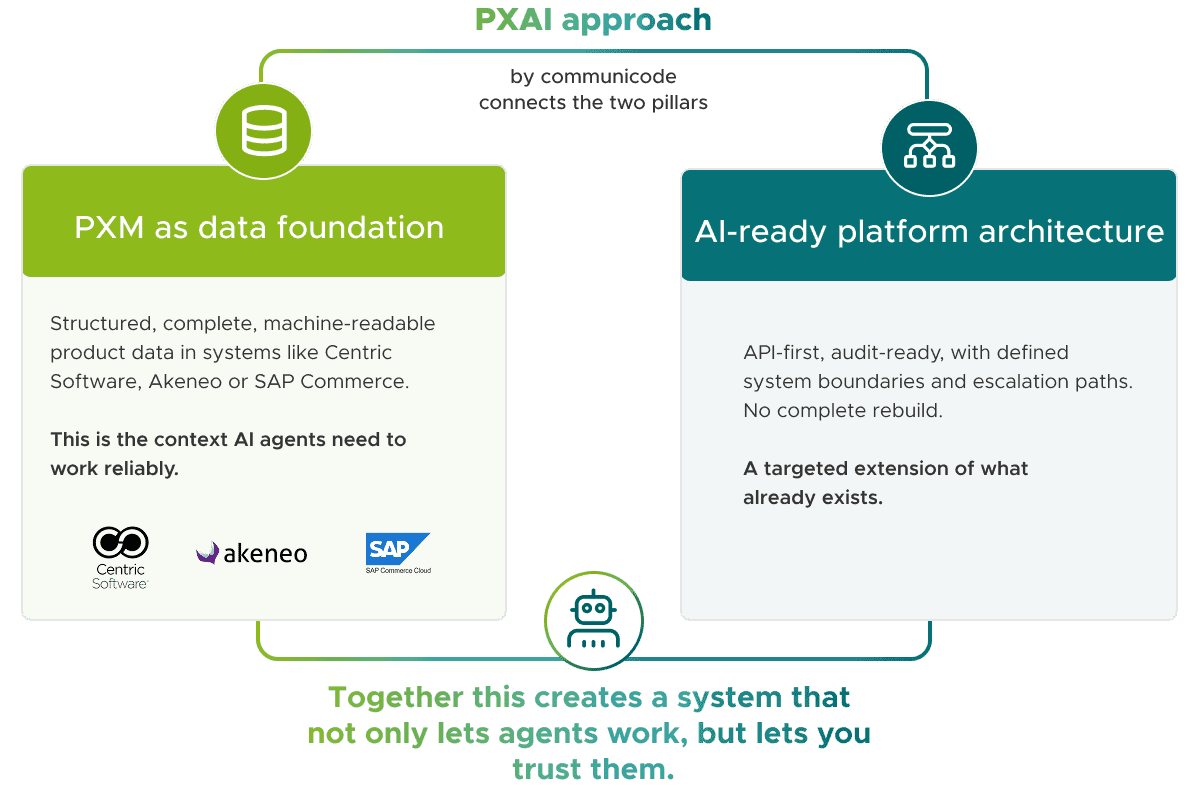
communicode’s PXAI approach combines two pillars:
PXM as the data foundation
Structured, complete, machine-readable product data in systems such as Centric Software, Akeneo, or SAP Commerce. This is the context that AI agents need to work reliably.
AI-enabled platform architecture
API-first, audit-ready, with defined system boundaries and escalation paths. No complete overhaul. A targeted extension of what already exists.
Together, this results in a system that not only allows agents to work but also allows us to trust them.
An example from the industrial sector
A medium-sized manufacturer of technical components wanted to make its product range available on international procurement platforms, where AI agents automatically search for products and generate inquiries on behalf of buyers.
The problem: The platforms required complete, structured product data via an API. The manufacturer maintained its data in three different systems, with no clear ownership. Technical attributes were missing for about 30% of the SKUs.
The result: The manufacturer was listed on the platform. But agents skipped over its products because the data was insufficient for a reliable evaluation.
The solution did not lie in a better model or a new platform. It lay in the data foundation: a uniform attribute structure, a defined “source of truth,” and automatic completeness checks before API delivery.
Today, agents regularly evaluate the products on two platforms and include them in inquiries. Expansion into additional markets is now feasible because the foundation is in place.
Where does your system stand today?
Our Agentic Readiness Check soutlines in just a few minutes which of the five areas your system is already ready for and where specific action is needed.
Free of charge. No registration required.