The problem of the jack-of-all-trades
In practice, we at communicode often encounter situations where work is required in (too) many areas at the same time – webshop, customer portal, CRM, PIM, marketing automation, ERP.
The typical consequences are:
- Projects that have been started but not completed
- Overworked and frustrated project members
- Isolated systems without a uniform database
Successful digital or hybrid sales rarely fail due to a lack of ideas or motivation on the part of employees, but rather due to a lack of focus and prioritization at the management level. Unraveling the various project strands requires a lot of effort and the use of scarce resources, without adding value for the company. In the worst case, projects are stopped and a “business as usual” strategy is adopted.
The introduction of a hybrid sales model is less about new tools. However, a well-designed system architecture with a clear allocation of roles (single source of truth) and clean data is essential for successful implementation. Only the smooth interaction of these factors determines success.
Where is the focus in hybrid B2B sales?
A common approach to prioritizing digital sales initiatives is to decide between focusing on new customers or existing customers.
Focus on new customers: Reach, leads, and visibility
In most cases, focusing on new customers means drawing attention to your company, providing information, qualifying leads, and winning them over as customers with attractive offers.
The following measures are at the forefront:
- Content creation
- High-quality product information
- Online marketing, SEO, and campaigns
- Lead generation, qualification, and nurturing
- Uniform information base for marketing automation and CRM
This objective makes sense from a strategic point of view, but it is also challenging: ROI is delayed, processes must be set up cleanly, and there must be close collaboration between marketing and sales. In communicode's experience, the last point is a challenge, especially with limited budgets.
Focus on existing customers: efficiency and self-service
When prioritizing existing customer business, the focus is regularly on self-service functionalities and personalized content delivery.
Digital measures and tools often include:
- Self-service B2B customer portal combined with personal advice
- Personalized product, price, inventory, or delivery information
- Digital quotation and service processes
- Uniform information base for CRM, web shop, and ERP
While this approach may sound simpler, it does involve a number of risks:
- Providing personalized content can be technically challenging
- Customers may resist changes to familiar processes
- Sales teams may be reluctant to embrace digital tools and the associated changes to their role
The decision-making logic for decision-makers: Different perspectives create clarity
When introducing a digital sales strategy, there is one key question: “Which digital sales levers achieve the greatest business value at a reasonable cost?”
In our experience, looking at the question from different perspectives has proven to be the best way to answer it.
Internal Sales Perspective
The first step should be to look internally. Even today, many routine tasks are still performed manually that could have been digitized and automated long ago. These include, among others:
- Presenting product ranges and providing product information
- Responding to price and inventory inquiries
- Personally accepting repeat or replacement orders
- Lead evaluation and prioritization
- Identifying cross-selling and upselling potential
- Route planning
Which (recurring) tasks add little value but block a lot of internal resources? The higher the manual component of recurring processes, the greater the leverage of a digital approach.
External customer perspective
The second perspective, which is at least as important, is that of the customer. Since every customer has different expectations, it is worth dividing them into different customer groups.
The answers to the following questions may vary accordingly for each group.
- Which services must always be available digitally and immediately?
- For which services is personal advice still expected?
- For which customer groups do digital services provide relief rather than resistance?
Existing customers with clear needs are often grateful for self-service, even if internal assumptions suggest otherwise.
In such cases, communicode often uses the Walt Disney method, a creative method to help workshop participants work through given questions. This approach allows use cases that offer benefits for the company to be quickly identified.
The Business Value Matrix – The structured path to an implementation roadmap
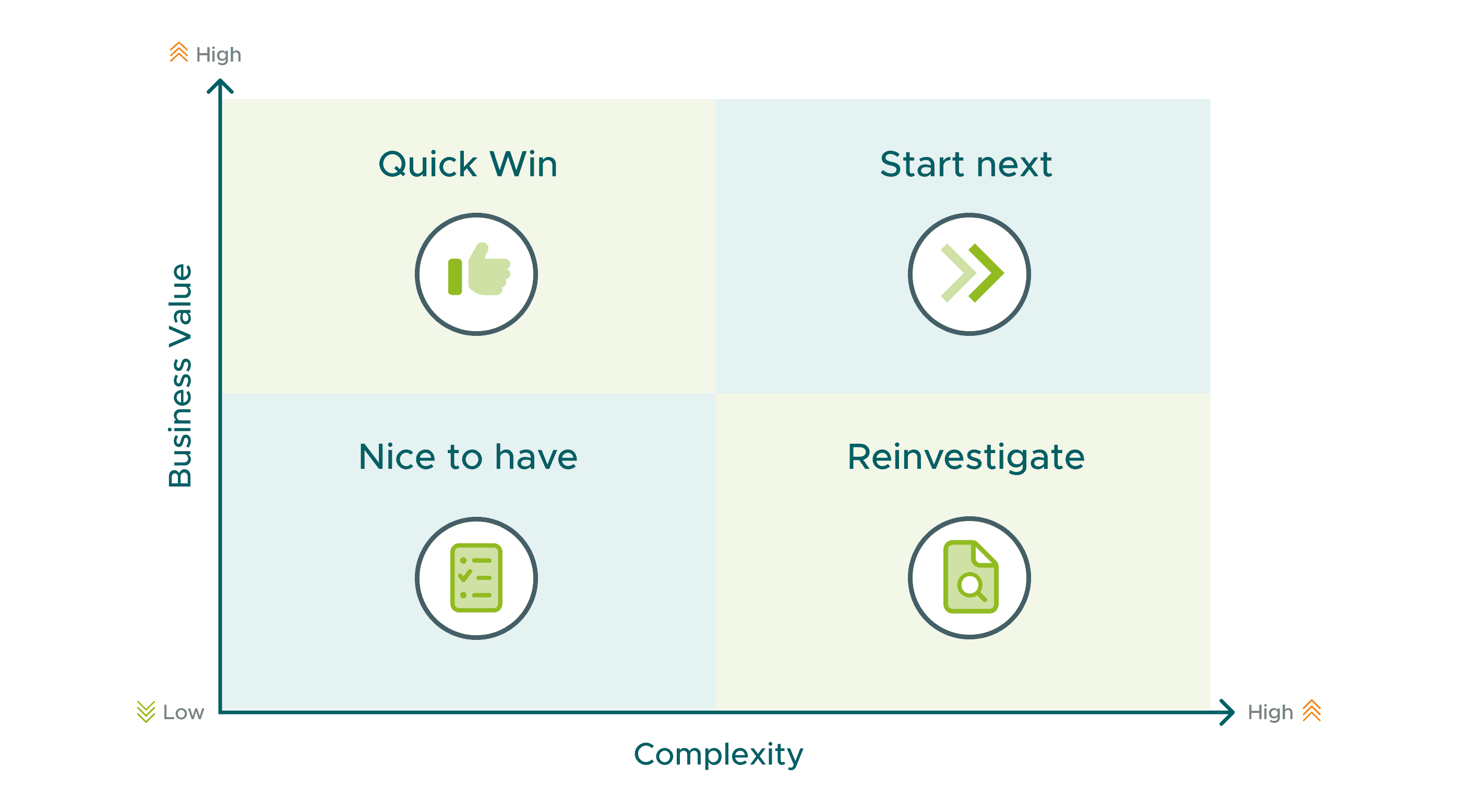
The Business Value Matrix has proven itself as a tool for the structured prioritization of use cases. It evaluates
- Added value for the company
- Complexity of implementation (technical, organizational, cultural)
In addition to budget and personnel, factors such as departmental boundaries, process maturity, and existing system landscapes are also taken into account. Visualization in a matrix enables a clear implementation roadmap with quick wins and strategic initiatives.
Hybrid sales – practical examples
Practical example 1: Self-service customer portal in hybrid B2B sales
Challenge
Due to historically grown structures, a B2B company provided its customers with product and order information such as descriptions, prices, drawings, instructions, etc. via different systems. Because customers found it very difficult to search for information, the sales force was contacted very frequently, which led to long processing times and manual coordination.
Solution
With the introduction of a customer portal, the information architecture was optimized in close consultation with customers and target group-specific information was made available at a central location. In the course of this, the portal was also introduced as an information platform for interested parties. This significantly reduced the number of corresponding customer inquiries.
Practical example 2: Integration of online and offline sales in B2B
Challenge
A large manufacturer of workshop supplies implemented its own online shop as part of an internally isolated project, with the aim of increasing stagnating sales as an additional channel to the traditional sales force. Initially, all products were offered with a welcome discount of 10%. Since the sales force did not participate in online sales, this led to the sales department viewing the shop not as an additional sales channel but as a competitive channel, and even undercutting the discounts offered there for its customers in order to achieve its own sales targets. The result was not an increase in sales, but a decline in margins and a significant loss of trust in the sales department.
Solution
Through intensive discussions with all parties involved, a plan was developed for how digital and analog sales could work together. The first step was to develop a commission system that allowed the sales force to participate in online sales. At the same time, the advantages of a digital product catalog for sales representatives were highlighted. Training enabled employees to use the online shop specifically as a presentation platform.
Critical success factors
Hybrid sales in B2B only works sustainably when strategy, organization, and technology work together. The critical success factors are summarized once again:
- Clear focus & prioritization according to added value
- Common goal and cooperation between marketing, sales, and IT
- Integrated system landscape with a clean database
- Acceptance in the field through relief rather than cannibalization
- Measurable KPIs and fast ROI to secure investments internally
Conclusion: Focus beats completeness
Digital support for field sales is no longer a trend, but a new reality. In this context, there is no longer an “either/or” situation, but also no “all at once.” The structured recording of requirements and their prioritization according to added value is important for the successful implementation of a hybrid sales strategy. The integrated and smooth interaction of CRM, ERP, shop, etc., as well as uniform and high-quality data form the foundation for this.
communicode supports companies on this journey:
- in prioritizing requirements
- in moderating between departments
- in developing a holistic system architecture, or
- in defining data models and processes
Our goal is to equip companies with the tools they need to be successful in the market. We support them in setting clear priorities, reducing complexity, and consistently aligning digital sales initiatives with business value. This results in sustainable, integrated solutions that meaningfully interlink sales, marketing, and IT and create measurable added value.

Michael Wolfframm
As a Business Consultant, Michael Wolfframm is responsible for the Business Solutions division at communicode. In his career - especially at Triumph (Japan) - he has intensively dealt with the processes around logistics and fulfilment in wholesale and e-business. (E-)Business consulting, conception and development of customer experience, online marketing and automation are among his current topics.