AI agents are ready to go. Is your product data ready, too?
AI agents need more than just a good tool: Three things that make your product data AI-ready
In conversations with clients, we’re currently hearing the same question a lot: “Do I even need SEO anymore? GEO is the big topic now, after all.” Our answer: SEO remains important because AI searches rely on the same web content that search engines index. What’s changing are the requirements for that content. If you want to be taken into account by AI agents and AI searches, you need structured, machine-readable, and – above all – consistent product data. Otherwise, you’ll simply be overlooked in the results.
I demonstrated how this works in practice in the webinar “AI Agents & PXM” together with Damian Deßler from ATAMYA. I’ll summarize the key takeaways here.
What does AI readiness mean in product data management?
AI readiness (also known as KI readiness) means that a company has the data, technical connections, and organizational rules required for a specific AI use case. In product data management, this primarily means that an AI agent can access reliable product information, and there are clear guidelines regarding what it is responsible for and what it is not.
We therefore consider AI readiness along three dimensions:
Data:
Is product information structured, complete, and consistent across all channels?
Technology:
Are systems and workflows connected in such a way that AI, automation, and human review work together seamlessly?
Organization:
Are responsibilities, permitted AI services, and the handling of company data clearly defined?
PIM, DAM, and PXM explained briefly
A PIM (Product Information Management) system is the central repository for product information. A DAM (Digital Asset Management) system manages the associated images and documents, such as certificates. PXM (Product Experience Management) uses both to provide the right information for every target audience and every channel.
In short: PIM is the foundation; PXM is the goal.
AI readiness means that a company has the data, technical connections, and organizational rules necessary for a specific AI use case. The key question now is: Can the AI agent access reliable information, and is it clear what it is responsible for and what it is not?
Why scattered product data slows down AI agents
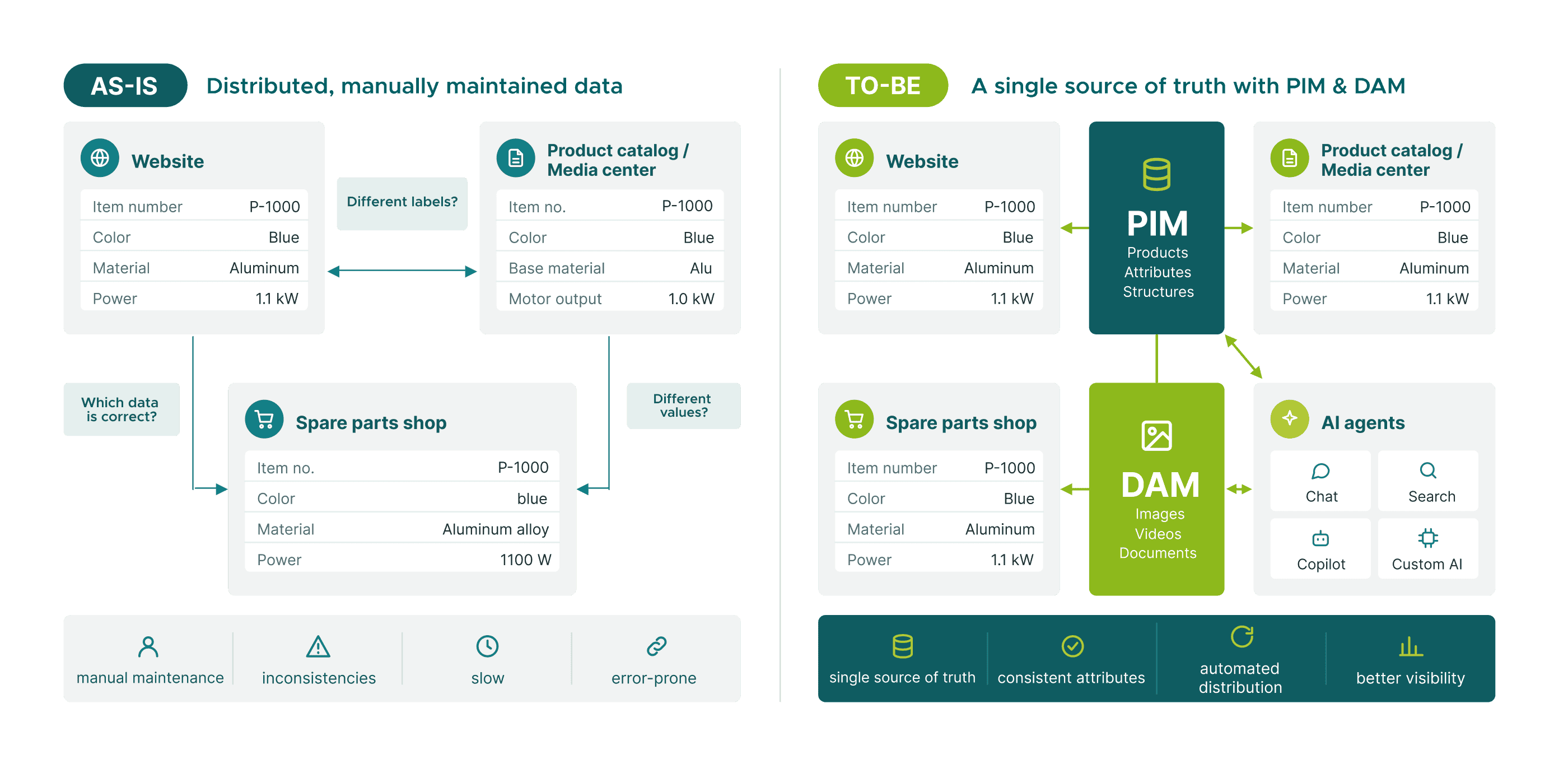
Many companies are familiar with this scenario: The corporate website displays products, images, and category pages, maintained by online editors – often still largely manually. For details, it refers users to a product catalog or a media center – that is, a different system with a different structure. On top of that, there may be a spare parts store with its own set of data.
The result is inconsistent attributes. Each system is maintained for its own purpose, but none are aligned with the others. When AI search starts putting pressure on the system, people apply quick fixes here and there and make manual adjustments. This is slow, error-prone, and time-consuming – and yet it still fails to deliver the desired visibility.
1. Structured product data is what makes AI agents usable
Without a clean data model, an AI agent has nothing to rely on. In our webinar, we demonstrated live just how quickly such a model can be designed today.
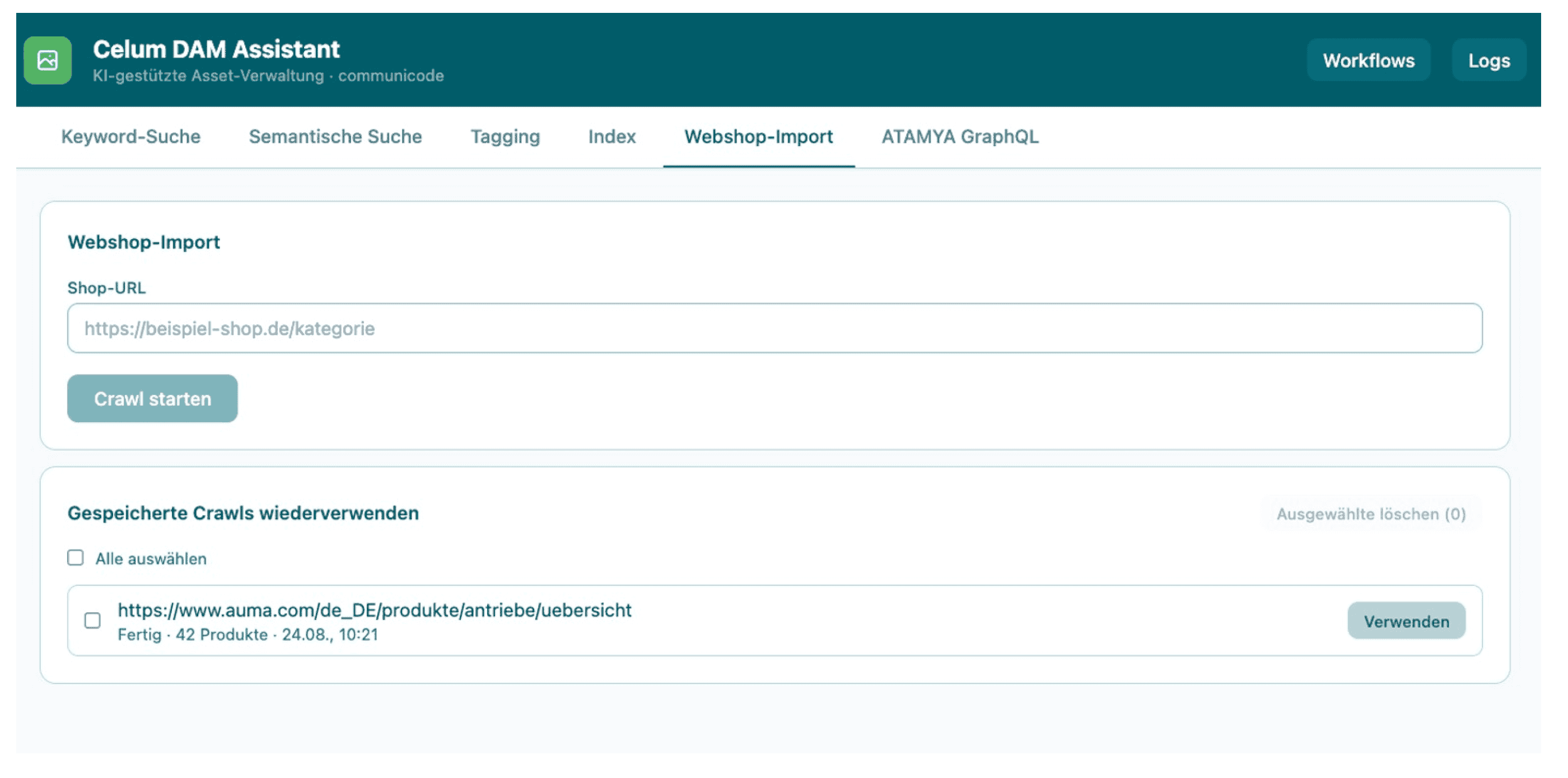
For the showcase, we had product pages from a client’s website crawled. Our PXM Assistant captured categories, attributes, and values and converted them into a data model that can be transferred to ATAMYA without manual input. In this example, there were 42 products, four object types, and 53 attributes. The transfer took place live.
Damian made a telling observation on this point: Developing a data model in collaboration with a company can take months. AI doesn’t replace this work, but it does quickly provide a proposal that you can work with. The same principle applies when you need to incorporate a large amount of supplier master data into your target data model.
Where human input is still needed
The assistant also suggested attributes that it would merge. “Setting time” and “setting time range” can be easily consolidated. With “housing material” and “screw material,” however, it’s not quite as clear. Similar does not mean synonymous. Whether two attributes belong together is determined by product knowledge, not linguistic similarity.
2. Data Quality Requires Clear Workflows and Targeted Checks
The real work begins with the import. Damian demonstrated what this can look like in a defined workflow.
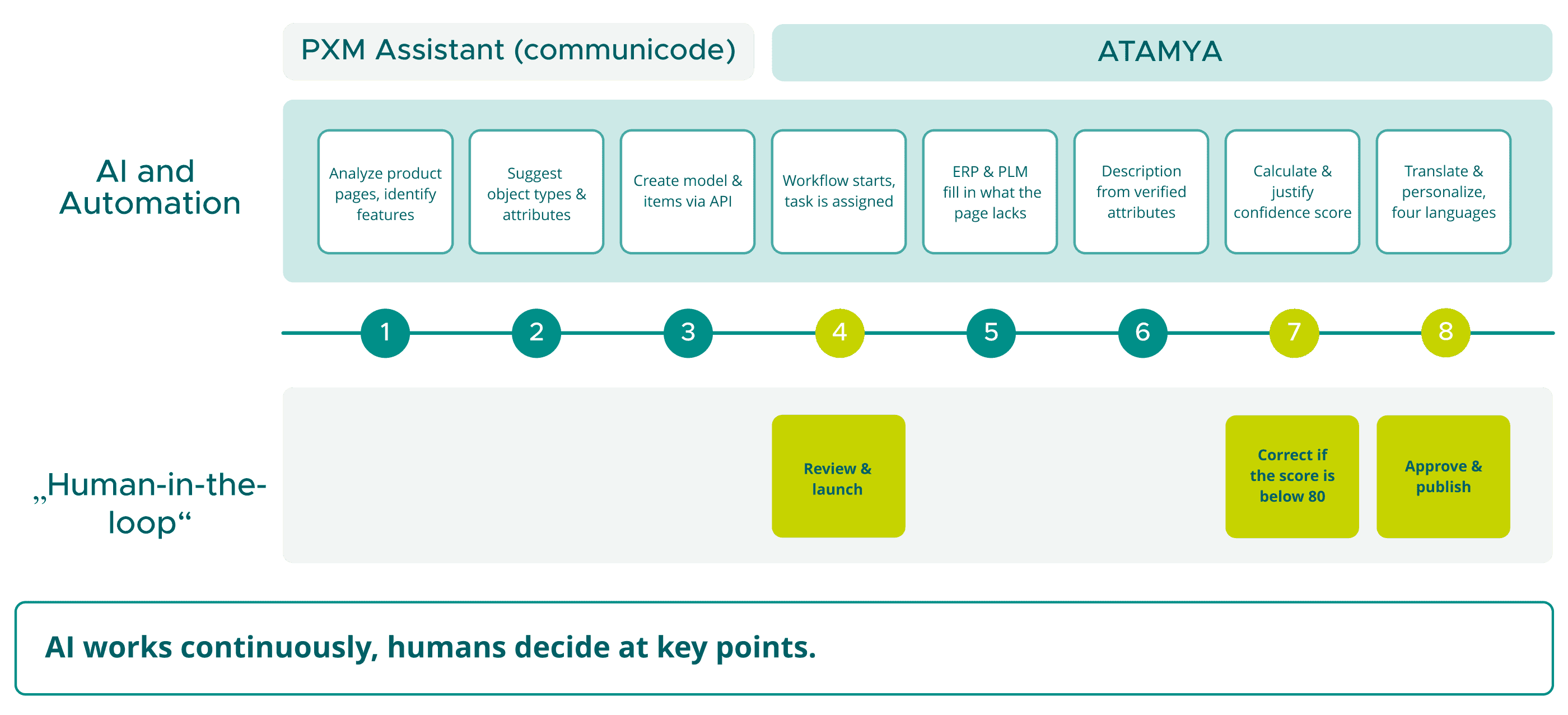
As soon as a product is created, a task is automatically generated for the product manager. Using a form, the product manager specifies which languages the product will be translated into, for which target audiences the texts will be tailored, and for which channels the product will be prepared. After that, much of the process runs in the background: data from the ERP system is integrated, attributes are derived, and an AI agent drafts the product description.
Quality gates and confidence score: How data quality is checked
The second agent in the workflow is particularly insightful. It doesn’t write anything; it only checks. This governance agent analyzes the data, evaluates it with a confidence score, and shows the product manager where to take a closer look. For products with hundreds of attributes, this is a real help.
A quality gate is a defined checkpoint in the workflow where a human is involved. In the example, the threshold was set at 80 percent. The product scored 45 percent, so the task was assigned to a human. Important: The score serves as a decision-making aid in this workflow; it is not proof of technical accuracy.
The product manager did indeed find a value that couldn’t be correct and corrected it. As a result, data quality in the PIM rose from 42 to 74 percent and, following the latest additions, to 100 percent. These additions include information that does not come from the AI:
Units:
If a weight is imported from an external system in grams, the PIM converts it to the base unit based on predefined rules.
Standards and Specifications:
These are added by the subject matter expert.
Certificates:
They are assigned directly from the integrated DAM, which is particularly important for customers in technical fields.
A second quality gate focused on the product descriptions. The AI had generated them in a neutral tone and additionally tailored them for different target audiences, such as engineering and technical procurement. Both versions are based on the same approved attributes but place different emphases. The text was translated into English and Chinese; in the demo, DeepL was used. A structured representation for generative searches can also be provided via interfaces.
What AI should and shouldn’t handle
Just because you can do something with AI doesn’t mean you should automatically do it. The example workflow consisted of eight steps and three decisions. Much of this involves classic automation with fixed rules, the kind that can also be built using tools like n8n or Make. AI comes into play where text is generated or data is evaluated. The human in the process (human-in-the-loop) focuses on what they do best: evaluating, deciding, and approving.
Traceability is essential
Proper oversight requires a complete audit trail. Your team must be able to see at any time which values were changed by a person and which were generated by the workflow or AI – even at the level of individual attributes. Especially when using AI, this is not optional.
3. AI Readiness Requires Clear Responsibilities
Of the three dimensions, organization is the biggest hurdle. Data and technology can be managed. But if the processes don’t work, people aren’t on board, and no guidelines are defined, even the best tool won’t help.
Before getting started, these questions – among others – should be clarified:
- Do employees use a company account for AI tools, or does everyone have their own?
- Which platforms are permitted?
- Is the use of AI GDPR-compliant?
If you don’t clarify these points, you might as well forget about the whole thing.
Will we still need a PIM in the future?
We occasionally hear: In five years, there won’t be any PIM systems left; an agent will retrieve data from all systems, consolidate it, and output it. Technically, this is conceivable with the appropriate effort. I see it differently. The focus of the PIM is shifting; it’s no longer just about structures and classifications. However, an agent will only be interested in your data if the underlying structure is sound. The PIM remains the foundation upon which consistency across all channels is built.
Where does the competitive advantage lie?
Your competitors can also purchase the AI tool. The difference lies in what comes before and after: data, processes, and responsibilities. Those who maintain their product data in a consistent, structured, and traceable manner are better positioned to be considered by AI searches and agents. New use cases can then be implemented on an existing foundation, rather than starting the data cleansing process from scratch with every project.
Conclusion: Start small, clarify responsibilities
You don’t have to overhaul your entire product catalog all at once. Choose a manageable product group and walk through the entire process from source to publication. These five questions will help you get started:
- Is there a single authoritative source for your product information, and are discrepancies between channels visible?
- Are attributes, units, and the assignment of documents clearly defined?
- Do you know which steps to automate using rules, where AI provides support, and where a human performs checks?
- Can you trace who or what changed a value?
- Have responsibilities, permitted AI services, and the handling of company data been clarified?
Open-ended answers aren’t a problem – they show where you can start. If you’d like to assess your current situation more precisely, our Agentic Readiness Check is a good first step. Afterward, we’ll work together to determine which process is best suited for your implementation.
FAQ – Frequently asked questions about product data AI Readiness

Mischa Wolfframm
Mischa Wolfframm is Director of Consulting at communicode and supports companies in digitally and efficiently aligning their commerce and process landscapes. His focus is on scalable solutions that noticeably improve sales, logistics, and fulfillment processes. Mischa previously gained international experience at companies including Triumph in Japan. When he's not working on digital process chains, he talks about B2B commerce strategies, automation, and pragmatic solutions that really work in everyday life.