GEO by numbers: What recent studies on AI Search reveal

Most Google searches now end without a single click
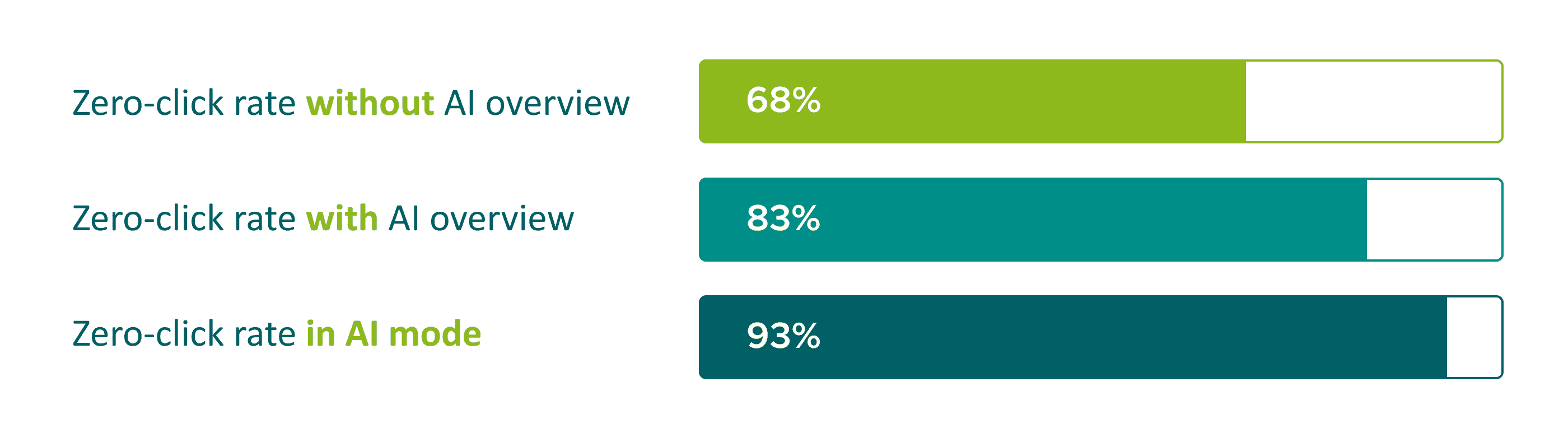
According to an analysis by SparkToro and Datos, around 68% of all Google searches in the U.S. now end without a single click on an external website. This means that fewer than one in three searches actually leads to a visit to the open web.
The trend becomes even clearer as soon as an AI-generated overview appears. As soon as Google displays an AI Overview, the zero-click rate is around 83%; in Google’s new AI Mode, it’s even as high as 93%. Particularly noteworthy: According to the Pew Research Center, users click on one of the sources cited in an AI Overview in only about 1% of cases, even though these sources are visibly linked there. Apparently, simply being mentioned is enough – users still usually don’t click.
For businesses, this has tangible consequences that go beyond a mere decline in traffic. Traditional performance metrics such as sessions, page views, or form conversions on a company’s own website lose their significance when a growing portion of the target audience no longer accesses the relevant information on the site itself.
This particularly affects content designed to capture attention at the beginning of the purchasing decision: how-to articles, product comparisons, or FAQ pages may still be heavily used without this being reflected in the familiar analytics figures. If this isn’t taken into account, it’s easy to get the false impression that a topic or content format has lost relevance, even though it’s simply being consumed differently – namely, within a generated response rather than on the company’s own site.
At the same time, the actual value driver is shifting: It’s not the click that determines impact, but rather whether your company is mentioned in the answer at all, how it’s portrayed there, and whether this mention later leads to a deliberate, direct search for the brand.
AI search is growing faster than most people expect
Google itself announced at I/O 2026 that AI Mode has surpassed the one-billion-monthly-active-users mark, with query volume more than doubling quarter over quarter. ChatGPT now processes an estimated 1.6 to 2 billion queries daily.
Gartner had already predicted in 2024 that the volume of traditional search engine queries would decline by 25% by 2026, as generative AI solutions increasingly serve as a substitute for traditional search queries. Whether this specific figure has actually materialized is a subject of controversy within the industry – however, the fundamental trend toward fragmented search across multiple AI engines is considered undisputed.
B2B buyers have long been using AI as their primary research tool
One figure is particularly revealing for the B2B sector: According to Forrester, 89% of B2B buyers now use generative AI as their primary tool for independent research. Gartner found in a recent survey of 645 B2B buyers that 45% used generative AI for their most recent purchase; however, on average, they still consulted seven different sources of information before making a decision.
One consequence of this: The average number of vendors that B2B buyers even include in their shortlist has dropped from 3.2 to 2.5. Anyone who does not appear on this shortened shortlist is simply no longer considered in the procurement process – regardless of how good their offer might be in terms of content.
The example of an industrial supplier of machine components illustrates this impact well: A buyer looking for a replacement for a specific type of valve with particular pressure and temperature ratings is increasingly turning directly to an AI tool to find suitable manufacturers, rather than clicking through multiple catalogs. Only those manufacturers whose technical data is maintained consistently and accurately across all sources are listed. If the information is up-to-date only on the manufacturer’s own website but outdated on the partner portal, the manufacturer will most likely not appear in the results at all – even if its product would technically be the right solution. Instead, the buyer is presented with two or three alternatives and makes their shortlist without the actually suitable supplier ever being considered.
High adoption – But with reservations
The issue of trust is also interesting: According to Gartner, 70% of B2B buyers now prefer a fully digital, self-directed buying experience without direct contact with sales, with 45% of them having used AI during their research. At the same time, 69% state, that they still want to validate the information provided by AI with a sales representative afterward, in part because 51% of respondents assume they are more likely to encounter misleading information in generative AI than in a traditional sales conversation.
This tension – high usage coupled with cautious trust – also explains why, according to Forrester figures, 20% of buyers actually felt even less confident in their decision after conducting AI-assisted research because they had encountered unreliable or contradictory information.
What these numbers mMean for marketing professionals
Taken together, a clear picture emerges: AI-generated responses are already the first – and often the only – point of contact for many selection processes, even before a sales conversation takes place. At the same time, users are increasingly failing to click through to a company’s website, even when the company is mentioned in the response.
For companies, this represents a shift that can no longer be captured solely by traditional SEO metrics. Anyone who still focuses exclusively on rankings, sessions, and click-through rates today is missing a growing portion of their own selection process because it has already taken place beforehand – within a generated response. The real question, therefore, is no longer how to rank for a search engine, but whether your company is even part of the answer that an AI provides to a potential customer. And this question cannot be answered once and for all and then checked off the list: Since the underlying models are constantly evolving, visibility that exists today may already be gone tomorrow, even if nothing has changed in terms of your company’s content.
This shift inevitably raises the question of what a company actually needs to provide in order to appear in these generated responses at all – and to be reliably mentioned as the underlying models continue to evolve. A key component of this is consistent, structured product data, such as that typically maintained in PIM and DAM systems. Equally crucial is the ongoing monitoring of a company’s own visibility, because only those who regularly check how and whether their company appears in relevant AI responses can take timely corrective action, rather than noticing a gradual loss of visibility only when it has already resulted in a decline in inquiries. We’ve examined this relationship in more detail – and how such ongoing monitoring can be implemented organizationally – in two separate articles.
Knowing the numbers is the first step – We’ll show you where you stand today
Statistics like these are a good wake-up call, but they don’t tell you anything about how visible your company actually is in ChatGPT, Perplexity, Gemini, or Google AI Overviews. This is exactly where communicode comes in: Through a structured AI visibility analysis, we determine how often and how prominently your company appears in generative responses to relevant topics, how this compares to the competition, and where content or data gaps are currently holding back your visibility. This results in a prioritized, actionable roadmap – the ideal starting point for moving from study figures to your own, reliable set of facts.

Nicole Teckentrup
Nicole Teckentrup is Online Marketing Lead and is responsible for ensuring that digital initiatives yield measurable results. She brings deep expertise in SEO/SEA to the table and leverages GEO as a new discipline to secure long-term digital visibility. She remains constantly curious about new knowledge, new methods, and technological developments – because online marketing continues to evolve, and she evolves with it.