Managing GEO: What marketing does on its own, what commerce must deliver

What matters
Three factors determine whether a company appears in generative responses:
Google ranks, ChatGPT quotes
Generative engines look for clear, unambiguous statements that can be incorporated into a response without interpretation. A paragraph that answers a question directly and precisely is more likely to be cited than a text that artfully paraphrases the topic and doesn’t provide the actual answer until the third sentence.
Consistency across all sources
If a website, product data sheet, marketplace listing, and partner portal provide different wording and figures for the same information, the engine cannot derive a reliable answer. In this context, consistency trumps the most creative phrasing.
Ongoing monitoring instead of a one-time project
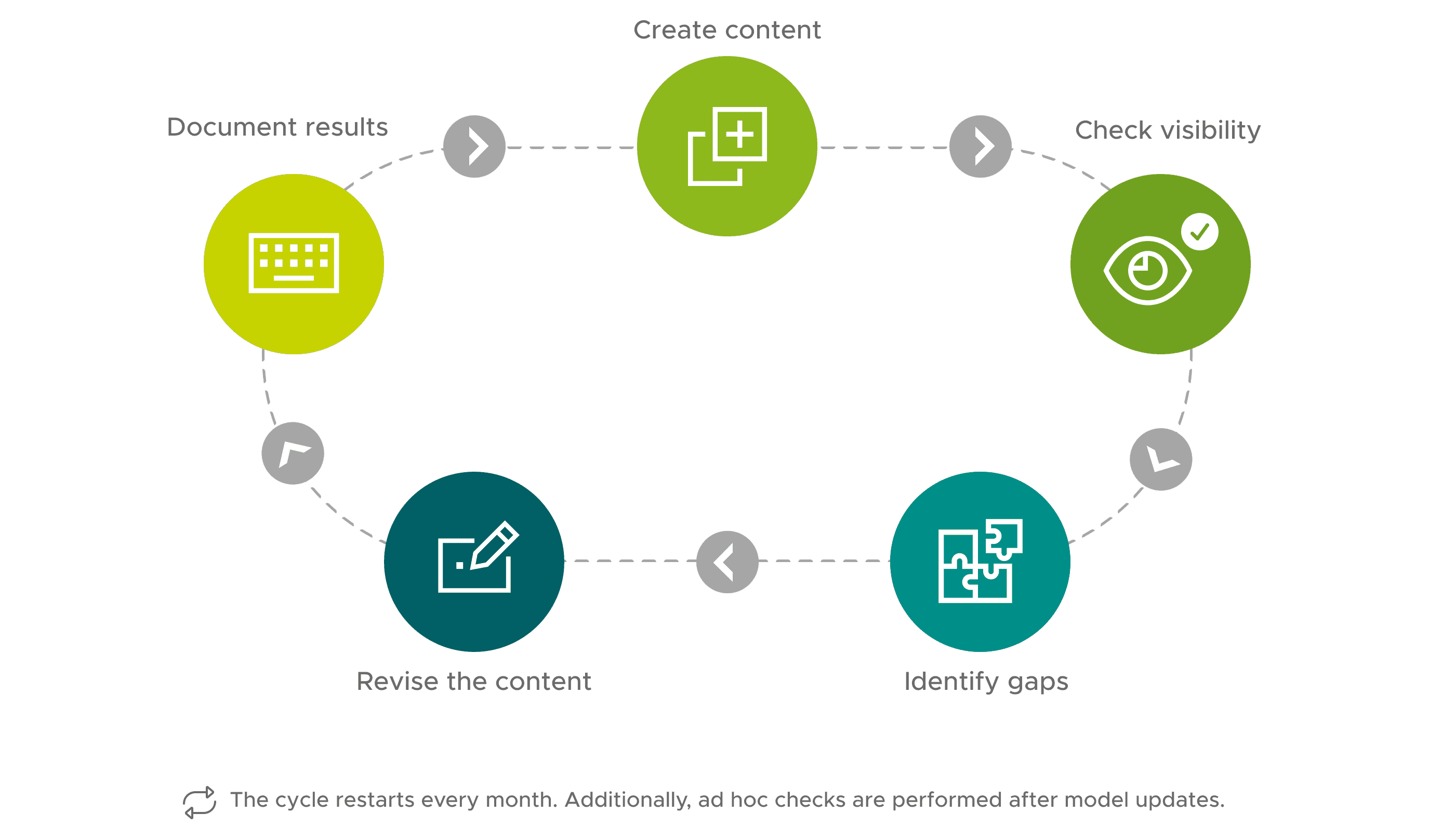
Major providers update their models at frequent intervals. Visibility that exists today may disappear again after the next model update. GEO therefore requires a consistent rhythm, not a completion date in the project plan.
These three points define the division of responsibilities between the marketing team and the commerce or product data team.
What the marketing team can do on its own
Most of the day-to-day work falls to the marketing team itself and can be integrated into existing editorial processes.
Question-based content structure
At its core, the goal is to structure content so that it directly answers specific questions from the target audience, rather than embedding them in a long block of text. FAQ sections, clearly formulated definitions, and distinctions such as “is equal to” and “is not equal to” make it easier for search engines to cite content precisely, rather than having to piece together a statement from multiple sentences.
Topic clusters instead of individual articles
It’s equally important to consistently cover a topic across several related posts and link them clearly within the site, rather than publishing isolated articles without a discernible common thread. Such topic clusters significantly increase the likelihood of being recognized as a subject-matter authority by generative engines – far more so than a single article, no matter how well-written it may be.
Monitoring your own visibility
To ensure this work isn’t in vain, it’s important to regularly monitor your own visibility: whether and how your company appears in responses from ChatGPT, Perplexity, Gemini, and Google AI Overviews to relevant search queries. This is essentially no different from ranking tracking in traditional SEO, just with different metrics. If this monitoring reveals that competitors are cited on certain topics while your company is not, you can specifically address the corresponding content gaps or revise existing content.
Content gap management
If this monitoring reveals that competitors are cited on certain topics while your own company is not, you can systematically address the corresponding content gaps or revise existing content.
Briefing for technical teams
One final, often overlooked component: Schema markup for articles, FAQs, or products first requires a solid technical foundation. Here, the IT department establishes a one-time framework and processes – such as which templates or systems output structured data. Once this foundation is in place, the marketing team can largely handle the content design independently: The technical requirements for Schema markup can be defined and maintained by the marketing team without having to rely on the development or commerce team for every adjustment.
This results in a process – following a one-time coordination with IT – in which Marketing can independently manage the majority of the content-related work.
What is expected of the commerce or PIM/DAM team
However, there is one area where marketing hits a hard limit: the underlying data quality. This is where clear expectations are needed from the team responsible for commerce or PIM/DAM:
- Consistent product attributes across all output channels: the same product name and the same technical specifications, whether in the online store, on a marketplace, or in the partner portal.
- Completeness of required attributes, especially for the characteristics that are actually searched for in queries, rather than just the fields required for administrative purposes.
- Technical implementation of structured data (schema markup) on product, category, and FAQ pages, based on marketing requirements.
- Consistent data quality during system changes or migrations, so that visibility once established is not lost again due to technical changes.
- Clarity regarding interfaces and export processes: Which data comes from which system? This allows the marketing team to independently identify and resolve inconsistencies.
Without this foundation, even the best content work in marketing remains ineffective because the engine receives contradictory or incomplete signals and cannot derive a reliable response from them.
How to manage the entire project in a scalable way
To ensure that GEO does not become a one-person project, a lightweight yet binding management model is needed.
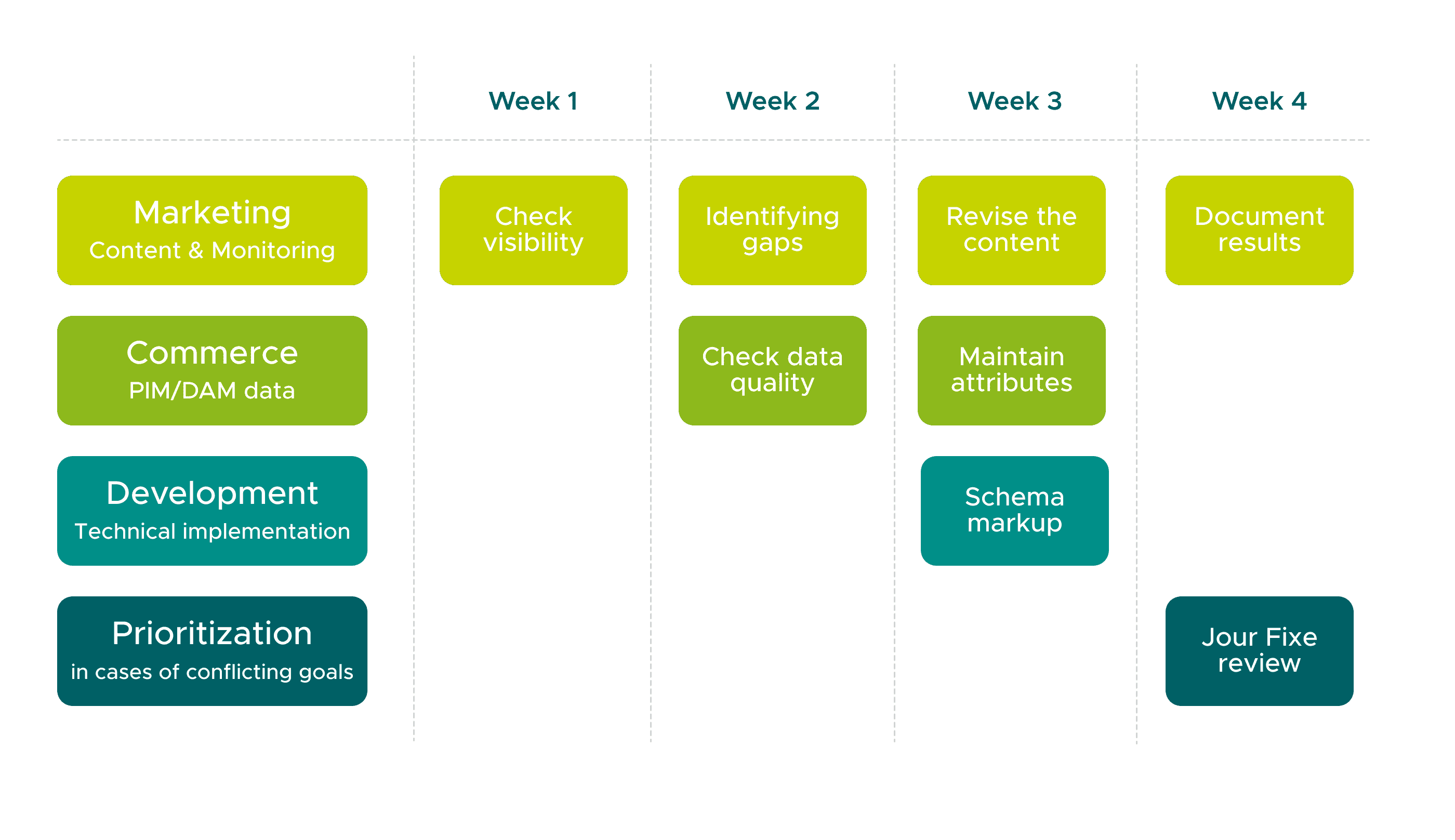
A model with four clearly distinct roles – rather than gaps in responsibility – has proven effective in practice: Marketing is responsible for content and monitoring; the Commerce or PIM team is responsible for data quality; Development is responsible for the technical implementation of structured data; and a person at the management level is responsible for prioritization whenever conflicting goals arise between the teams. Without this fourth role, GEO regularly gets stuck in practice at the point where marketing and commerce priorities clash.
Equally important is a fixed monitoring schedule. A quarterly review is usually insufficient, as models change faster than traditional reporting cycles allow for. A monthly review of visibility, competitive analysis, and new content gaps has proven more practical, supplemented by an ad hoc review whenever one of the major providers rolls out a known major model update.
To ensure that this rhythm does not lead to separate marketing and IT reporting, a shared set of metrics visible to both sides should serve as the foundation: visibility in generative responses, performance compared to the competition, and the number of outstanding content and data gaps. A brief, regular coordination meeting between Marketing and Commerce – or PIM/DAM – ensures that new insights from monitoring are directly translated into concrete tasks for both sides, rather than getting lost in a backlog that no one prioritizes anyway.
The first step is crucial – We’ll take it with you
The initial phase – from the first assessment to establishing a joint governance model between marketing and commerce – is rarely something that can be built up on the side, especially when day-to-day operations are running in parallel. This is exactly where communicode steps in: We help you systematically capture your current visibility in actionable insights, identify the largest data and content gaps, and use this to develop a concrete, prioritized roadmap for the first steps. Building on this, we also guide you through the rest of the process – from defining a suitable set of metrics, to coordinating between marketing and PIM/DAM teams, to determining which measures can be implemented internally and where additional support is needed. This transforms what is often a vague topic into a tangible, jointly supported plan.
Conclusion
GEO cannot be solved by good copy alone, nor can it be solved by cleaner product data alone. It requires both, with clearly defined responsibilities and a consistent rhythm that extends beyond a one-time project. Those who clarify this division of responsibilities from the outset avoid later discussions about why their visibility is lacking despite good content – or why clean data alone does not generate citations in generative responses.

Nicole Teckentrup
Nicole Teckentrup is Online Marketing Lead and is responsible for ensuring that digital initiatives yield measurable results. She brings deep expertise in SEO/SEA to the table and leverages GEO as a new discipline to secure long-term digital visibility. She remains constantly curious about new knowledge, new methods, and technological developments – because online marketing continues to evolve, and she evolves with it.