Does your brand truly have a system – or just guidelines?
Are you familiar with these challenges?
- Your brand has different effects depending on the channel.
- Releases take longer than planned.
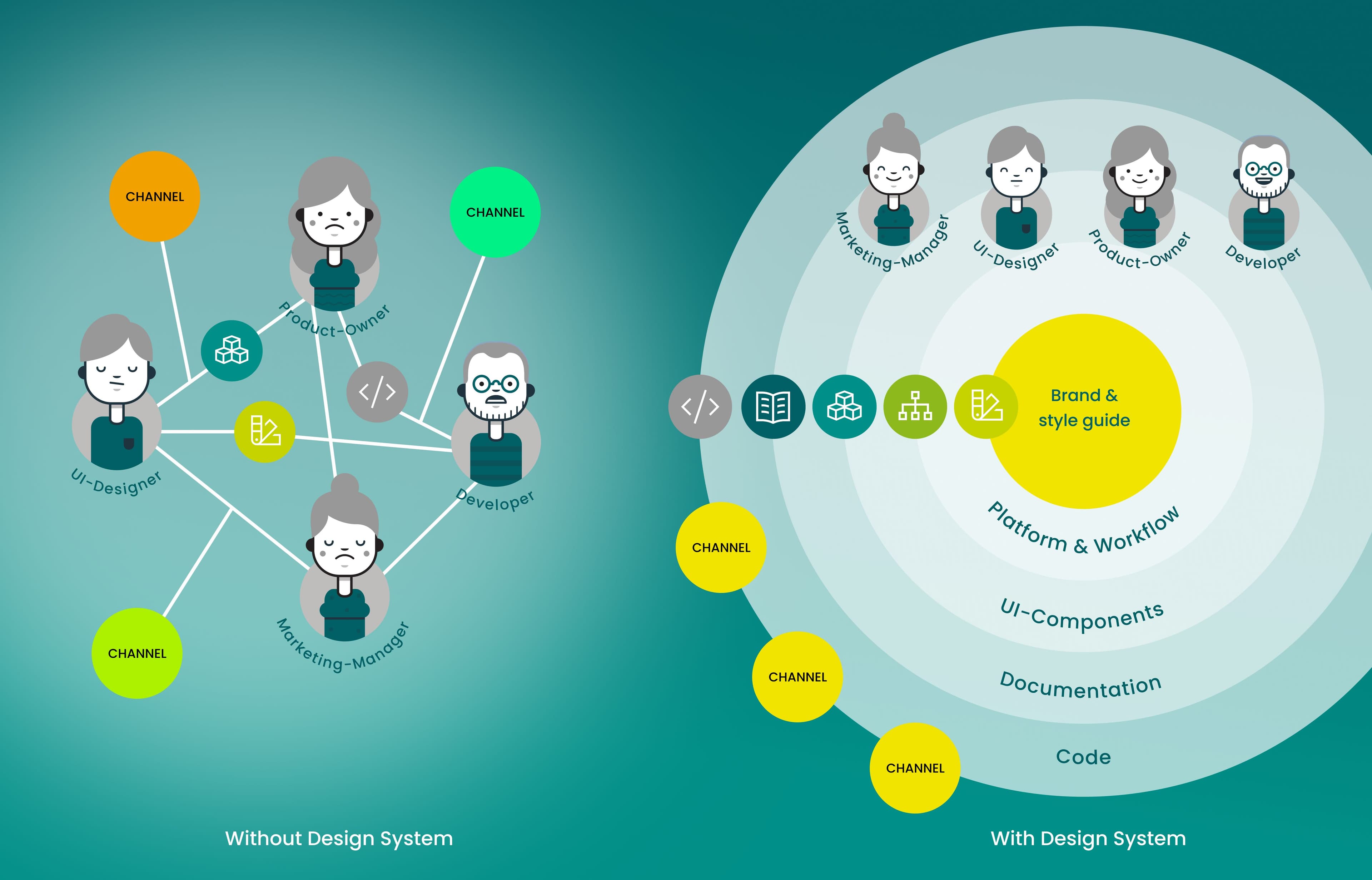
- Marketing, UX, and development work in parallel, instead of collaborating.
- Every new initiative feels like it starts from scratch.
This isn't a skills problem, it's a structural problem.
Many companies invest heavily in marketing, technology, and product development. They have a strong corporate design, clear brand values, and experienced teams. And yet, they struggle with inconsistent user experiences, friction between departments, and unnecessarily long coordination processes.
The reason is rarely a lack of skills.
The reason is usually: A lack of systematic approach.
Why visual guidelines alone don't enable scaling
Traditional style guides provide orientation, but not scalability.
Digital touchpoints are growing faster than organizations. New platforms, new features, new requirements. Without a binding foundation, complexity gradually builds up, and valuable speed is lost.
The crucial question is:
Do you have a scalable Single Source of Truth that connects brand, UX, and technology?
Design systems as a strategic lever
Successful companies don't work with isolated documents, but with design systems.
The difference is measurable in:
- shorter time-to-market
- consistent brand experiences across all touchpoints
- more efficient collaboration between design, development, and marketing
- sustainable use of resources
A design system is not a passing trend.
It is a strategic lever for digital performance and brand management.
Whitepaper: Setting up design systems correctly
In our whitepaper, you will learn:
- why classic style guides are no longer sufficient,
- what structural requirements enable scalable brand experiences,
- how to break down silos and enable teams to collaborate more efficiently, and
- how companies can sustainably improve their digital brand performance.