DAM + AI: Intelligent Asset Management Strategies for Omnichannel Excellence
Companies today invest enormous budgets in e-commerce platforms, campaigns, marketplace integrations, and social media strategies. And yet, customers frequently experience inconsistent brand presentations: product images differ depending on the channel, PDFs are outdated, social media uses different assets than the webshop, international markets work with their own versions of assets, and marketing teams waste time on manual reconciliation.
Omnichannel isn't a marketing problem – it's an architecture problem
The root cause is rarely in the frontend. It lies in the backend – more precisely, in how digital assets are managed, orchestrated, and delivered. Without a strategically integrated Digital Asset Management system, omnichannel inevitably becomes a patchwork. Assets are scattered across file servers, cloud storage, or SharePoint structures, versions are difficult to track, and cross-system automation is virtually impossible.
Only a central DAM system, enhanced with AI capabilities, creates the foundation for consistent, scalable, and personalized omnichannel experiences. Those still managing assets manually today will be left behind tomorrow.
Digital Asset Management as the Foundation of Every Omnichannel Strategy
Content demands are growing exponentially today. Assets must be available simultaneously for webshops, marketplaces, social media, print, and portals. International markets require localized versions, campaigns demand personalized variations, and AI-generated content is an additional factor. At the same time, internal teams and external partners expect fast, error-free access via self-service structures.
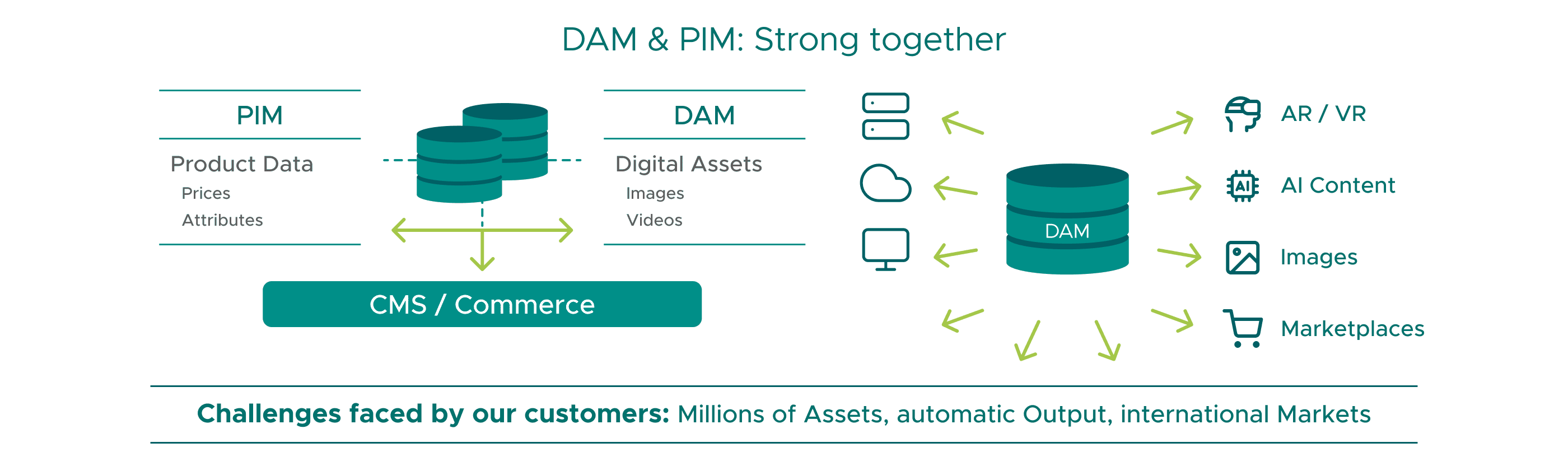
In this reality, simply maintaining product data cleanly in a PIM system is not enough. A PIM only manages product data, attributes, prices, and classifications, but not media logic. Only the interplay of PIM, DAM, and commerce systems creates a robust omnichannel content architecture. The DAM system assumes the role of the single source of truth for assets: It ensures that images, videos, documents, and other media are centrally maintained, versioned, and automatically distributed to all channels.
The AI functions within the DAM reduce manual processes, improve discoverability, and enable personalized media delivery.

Practical Examples
At communicode, we regularly implement such architectures in large-scale projects. For example, we implemented an architecture for one of the world's leading discount food retailers in which millions of product images are centrally managed, automatically processed, and consistently distributed across all channels. For Hörmann KG, we integrated DAM, PIM, and commerce systems to efficiently supply international markets with localized content.
What a Modern DAM with AI Can Really Do
A DAM is far more than a media archive. It's an orchestrating system that:
- provides structured metadata models to facilitate search, filtering, and variant management
- offers workflow and approval mechanisms for review and approval processes
- manages rights and variants, e.g. For example, for countries, markets, or channels
- enables automated derivative creation of images, videos, and documents
- ensures API integration with PIM, CMS, Commerce, and other systems
- implements AI-powered functions such as automatic tagging, semantic classification, and channel-based personalization
File servers or SharePoint structures cannot provide this. Only a strategically integrated DAM enables scalable omnichannel content orchestration, reduces operational complexity, and creates the foundation for future-proof, personalized content strategies. It is no longer a passive archive, but an active system within the digital value chain.
DAM and PIM: Differences, Interaction, and AI
We regularly encounter the question of whether a PIM is sufficient. The answer is clear: No.
A PIM manages structured product data such as prices, attributes, and classifications. A Digital Asset Management (DAM) system orchestrates unstructured digital assets, including versioning, rights management, automated distribution, and AI-powered metadata enrichment.
Only this interplay ensures that product data and assets appear consistent across all channels. Without integration, media breaks and manual processes occur. A DAM system as an orchestrating platform allows workflows to be automated, shortening time-to-market and creating consistent brand presentations.
AI amplifies this effect. It takes over tasks that are difficult to scale manually and, for the first time, makes content truly data-driven.
Integration and Architecture: The Key to Success
DAM projects rarely fail because of the software. They fail when architecture strategy, processes, and governance are lacking.
Successful projects require:
- a clear API strategy for PIM, CMS, and commerce integration
- event-driven architectures for automated deployment
- middleware concepts for complex data flows
- governance and role models
- clean metadata models
- AI integration for tagging, metadata enrichment, and personalization
At communicode, we view every DAM project as a transformation project, not an IT installation. Our focus is on unifying processes, automating workflows, orchestrating assets across systems, and using AI effectively where it delivers real added value.
Case Study
For an international retail group, we implemented middleware that connects PIM, DAM, and CMS. All product images are automatically delivered to portals, marketplaces, and catalog systems – including country and channel variants – supplemented by AI-powered tagging and automated content personalization.
Scalability for New Channels and AI
Headless commerce, AR and VR applications, dynamic personalization, and AI-generated assets are no longer just a vision of the future. With each new delivery logic, the number of asset variants grows exponentially. Those who continue to rely on manual processes quickly reach their operational limits.
A future-proof DAM system with AI manages variants automatically, intelligently enriches metadata, efficiently delivers large volumes of assets, and integrates into flexible architectures via APIs. This is precisely the difference between a tool and a strategic platform.
At communicode, we achieve precisely this scalability – even with millions of assets per year and in international markets.
Typical Pitfalls in DAM and AI Projects
In practice, we repeatedly see the same mistakes: DAM is implemented in isolation, metadata models are introduced too late, governance remains unclear, or AI is purchased as an add-on module without being integrated into existing processes. Often, there are also unrealistic expectations about what automation can achieve in the short term.
Those who consider architecture, processes, organization, and AI integration together early on create a sustainable foundation for omnichannel excellence.
Conclusion: Omnichannel Excellence Begins in the Backend
Digital Asset Management with AI reduces operational complexity, increases efficiency and reusability, enables personalization and consistent brand management. It creates the foundation for future-proof content architectures and prepares companies for new channels and technologies.
Our Appeal: Digital Asset Management is not a tool project. DAM + AI is a strategic architectural decision and the core of digital value creation.
Mini-Checklist: Is your company DAM + AI-ready?
- Are assets scattered across multiple systems?
- Do images need to be manually adapted for different channels?
- Are there inconsistencies between web, print, and marketplaces?
- Is your content volume constantly increasing?
- Are you planning new digital channels or internationalization?
If you answered "yes" to several of these questions, it's time for a centralized DAM + AI strategy.
Author

Michael Ochtrop
Michael develops technical and procedural concepts for the introduction of software solutions in organizations. From communicode's 20-year company history, he is familiar with almost every scenario in the data management context. His concern in the customer project is to make everyone involved convinced users and thus make the company more successful. After all, software only leads to improvements in conjunction with people and processes.