When is it time to change your DAM system? A guide for companies
Today, digital asset management (DAM) is much more than just an archive for images and videos. For many medium-sized B2B companies, it is a central component of their digital architecture – and therefore critical for efficiency, brand management, and growth.
As a digital agency, we have been supporting companies for many years in the selection, integration, and further development of modern DAM solutions. We are repeatedly confronted with the same question: When is the existing DAM system no longer sufficient, and when does a DAM system change make more sense than sticking with established structures?
Is your DAM system reaching its limits? Recognize the warning signs before it becomes costly!
This article offers practical guidance. It highlights typical reasons for changing your DAM system, identifies the risks of inaction, and helps you make an informed initial assessment. In practice, however, experience shows time and again that the final assessment is best made in a personal consultation, e.g., as part of a technology-neutral DAM consultation by communicode.
DAM as the foundation of modern digital processes
In recent years, the demands placed on marketing and content teams have increased significantly. Omnichannel strategies, international brand presence, personalized content, automation, and the use of AI have long been a reality. Content must be produced faster, delivered more consistently, and made available across an increasing number of channels.
A modern digital asset management system plays a key role in this: it not only manages digital assets, but also controls workflows, versions, rights, metadata, and increasingly also the connection to other systems such as PIM, CMS, or e-commerce platforms. communicode supports companies at precisely this interface – from strategic DAM consulting to system integration and scalable architecture.
However, many companies still work with DAM solutions that were originally designed for significantly smaller amounts of content and simpler processes. What used to be “sufficient” is now becoming a bottleneck – technically, organizationally, and economically. At this point, the question arises: When is it worth changing your DAM system?
Common reasons for switching DAM systems
Switching DAM systems is not an end in itself. It becomes necessary when the existing system no longer supports your company's current and future requirements. The following warning signs are particularly common in practice:
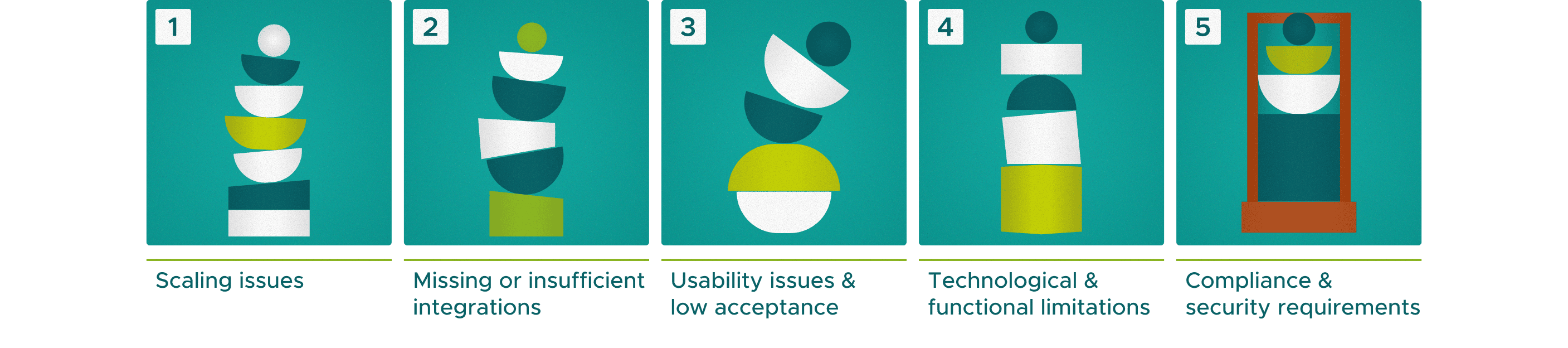
1. Scaling problems: When content grows faster than the system
Content volumes are growing exponentially. In addition to traditional images and PDFs, there are now videos, 3D data, animations, social media variants, campaign assets, and localized versions.
Typical signs of scaling problems in the DAM system are:
- noticeably longer loading times
- unreliable search and filter functions
- performance problems in day-to-day business
- necessary workarounds for system use
A future-proof DAM must be scalable – both technically and organizationally. If this is no longer the case, team productivity suffers considerably. communicode analyzes existing DAM architectures and develops future-proof, scalable solutions, often as part of a structured DAM migration.
2. Missing or insufficient integrations
A modern DAM only reveals its full potential when it interacts with other systems. These include, among others:
- Product Information Management (PIM)
- Content Management Systems (CMS)
- E-commerce platforms
- Marketing automation tools
In theory, many systems can be “integrated somehow.” In practice, however, it quickly becomes apparent that how a system can be integrated makes a big difference. If a cleanly documented API is missing or relevant business logic is not provided, fragile and maintenance-intensive custom developments are the result. This is precisely where it becomes apparent whether a DAM is technically future-proof. If integrations regularly become a cost driver, this is a strong argument for a change.
Practical example
In a project with a medium-sized B2B company, the marketing team had been using a DAM system for several years, which had originally been introduced for manageable amounts of content. With a growing product portfolio, new markets, and additional channels, the DAM needed to be more closely integrated with the existing PIM system.
At first glance, the integration seemed feasible: assets could be linked and basic metadata synchronized. In daily practice, however, it quickly became apparent that many processes only worked via manual intermediate steps. Metadata had to be maintained twice, approvals ran in parallel via email, and individual special solutions were created for each new campaign.
The situation became particularly critical when small adjustments – such as new asset types or additional markets – required a disproportionate amount of coordination and development effort. The cause was less the individual use case and more the basic technical model of the DAM system: although interfaces existed, central business logic was not provided cleanly and consistently via the API.
The situation was analyzed in a structured manner together with communicode. The conclusion: additional workarounds would have further increased complexity and running costs. The subsequent DAM system change created a clean integration basis, significantly reduced manual effort, and enabled stable, scalable processes between DAM, PIM, and other systems.
3. Usability problems and low acceptance
No matter how powerful a DAM system may be in terms of functionality, if it is not accepted by users, it misses its purpose.
Typical signs:
- high training costs
- complex, unintuitive user interfaces
- frequent queries or errors in asset usage
- use of shadow IT (local folders, cloud storage)
Marketing teams in particular now expect a user experience similar to that offered by modern SaaS solutions. If this is not provided, acceptance and thus the usefulness of the entire system declines. Usability, role models, and clear workflows are often underestimated success factors in DAM systems for B2B companies.
4. Technological and functional limitations
Technological development is advancing rapidly. Many older DAM systems can no longer keep pace with current requirements. Among other things, it becomes critical when important functions are missing or only available to a limited extent:
- cloud or hybrid operation
- AI-supported tagging and search
- support for complex asset types
- flexible taxonomies and metadata models
- variants and language versions
- translation management support
A DAM should adapt to your processes, not the other way around. If functional limitations dictate how you work, that's a strong signal that it's time for a change.
5. Compliance and security requirements
Data protection, rights management, and IT security are non-negotiable today. Requirements are constantly increasing, especially in the B2B environment with international partners and agencies.
Typical risks include:
- unclear or insufficient GDPR support
- missing or difficult-to-maintain rights and role concepts
- insecure access options for external users
- missing audit or logging functions
A DAM system that does not meet these requirements poses a real risk to your company – both legally and in terms of reputation. Compliance and security requirements must be taken into account both when selecting a system and when integrating it into existing IT landscapes.
Risks of not switching
An outdated or unsuitable DAM system rarely causes immediately visible damage. The consequences become apparent gradually:
- inefficient processes and rising operating costs
- time lost due to manual work and coordination
- inconsistent brand communication
- delayed market launches
- competitive disadvantages due to lack of agility
In short: Sticking with the wrong system will be more expensive in the long run than a professionally planned change.
Practical example
At one of our customers, marketing and product management had been using their own folder structures, Excel lists, and additional cloud storage for years to implement campaigns on schedule. New employees needed weeks to find their way around, and searching for approved assets was becoming increasingly frustrating.
It was only when an international campaign had to be postponed at short notice because image rights had not been clearly clarified and different versions of assets were circulating that the extent of the problem became apparent. The actual cause was not the individual project, but the outdated DAM system, which offered neither transparency nor clear rights and process logic. The realization came late, but it was clear: the inefficiencies that had been accepted for years had developed into a real business risk.
Approaches: Structure instead of actionism
Changing a DAM system is a strategic project and should be prepared accordingly. The following steps have proven successful:
1. Analyze the status quo: Which requirements does your current DAM meet and which does it not?
2. Define goals: Growth, internationalization, automation, AI?
3. Use a checklist: Evaluate functional, technical, and organizational criteria in a structured manner.
4. Plan migration realistically: Consider data quality, metadata, processes, and change management.
5. Involve external consultants: A neutral perspective saves time, costs, and wrong decisions.
Conclusion: Check regularly, act decisively
Changing your DAM system is not an end in itself. It becomes necessary when your existing digital asset management system no longer meets your current and future requirements. Growing amounts of content, lack of integration, usability problems, technological limitations, and compliance and security risks are clear warning signs.
Our appeal: Review your DAM system regularly and honestly. The sooner you recognize the need for action, the better you can minimize risks and seize opportunities.
communicode provides companies with comprehensive, practical support throughout the entire lifecycle of a DAM system change. Starting with strategic orientation and requirements analysis, through technology-neutral system selection and structured DAM migration, to technical DAM integration into existing system landscapes such as PIM, CMS, e-commerce, or marketing automation. We consider not only the technology, but also processes, data models, governance, and change management to ensure that the new digital asset management system is accepted in the long term, is scalable, and creates measurable added value for marketing and IT.
Further information and a structured checklist can be found here:
We would also be happy to assist you in a personal consultation to assess whether a DAM system change makes sense for your company – technology-neutral, practical, and future-oriented.
FAQ – Frequently asked questions about DAM system changes
Author

Michael Ochtrop
Michael develops technical and procedural concepts for the introduction of software solutions in organizations. From communicode's 20-year company history, he is familiar with almost every scenario in the data management context. His concern in the customer project is to make everyone involved convinced users and thus make the company more successful. After all, software only leads to improvements in conjunction with people and processes.