The fast DAM selection process: Two workshops for a well-founded decision
Many medium-sized businesses need a Digital Asset Management (DAM) system, but lack the time and resources for lengthy selection processes. At the same time, the decision needs to be robust, transparent, and future-proof.
It is precisely for this context that we at communicode have developed a rapid DAM selection process for medium-sized businesses. This compact, structured approach, delivered through two focused workshops, leads to a well-founded DAM recommendation that is tailored to the company and can be implemented quickly.
Why a Compact DAM Selection Process Makes Sense
In practice, we repeatedly encounter similar starting points with medium-sized B2B companies:
- limited resources in marketing and IT
- decision pressure due to time and budget constraints
- a confusing DAM market with solutions that are difficult to compare
- lack of experience in selecting systems
A classic, comprehensive selection process with extensive specifications, complex evaluation matrices, and numerous vendor presentations is often unrealistic in these cases. At the same time, a purely intuitive decision is risky, because a DAM system is a strategic platform that has a long-term impact on processes, data, and collaboration.
Our approach: Reduction to the essentials without sacrificing methodological quality. The result is a process that fits the working realities of medium-sized businesses.
The Process in Two Workshops
The rapid DAM System Selection Process follows a clearly structured, proven procedure. The goal is to establish decision-making capability within a few days – with minimal internal effort and maximum transparency.
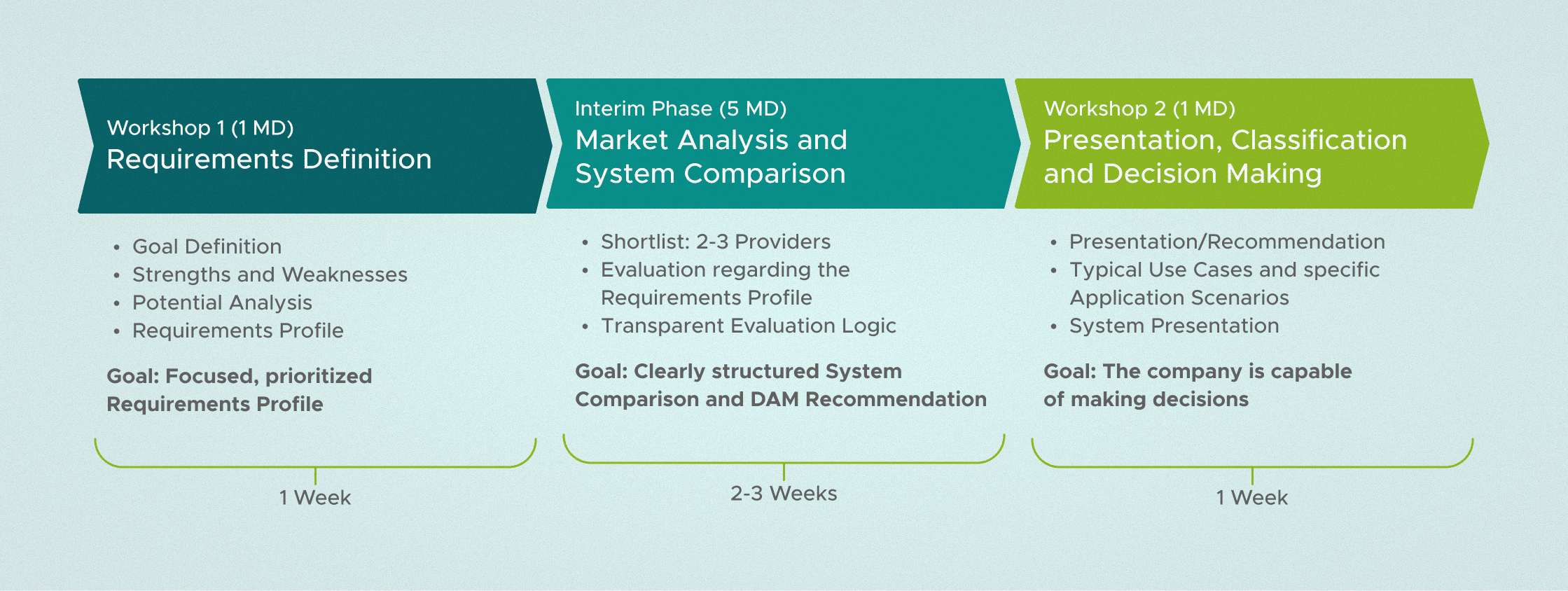
Workshop 1: Requirements Definition – Focus instead of feature collection
In the first workshop, we will work together to clarify the actual requirements. The focus is not on theoretical feature lists, but on real-world workflows and concrete goals.
Key questions are:
- What do the current content and media processes look like?
- Where do inefficiencies, duplication of effort, or media breaks occur?
- What roles and responsibilities exist now and in the future?
- Which asset types are relevant, and which metadata is truly necessary?
- Which integrations are required (e.g., PIM, CMS, ERP)?
- What technical framework conditions are in place (cloud, security, access rights)?
A crucial point is prioritization:
- Must-haves: absolutely essential for productive use
- Nive-to-haves: useful, but not critical to the decision; can be added later
Outcome of Workshop 1:
- a focused, prioritized requirements profile
- specifically tailored to medium-sized DAM scenarios
- serves as a solid basis for system selection.
Intermediate Phase: Market Analysis and System Comparison
Based on the defined requirements, we will conduct the market analysis. This relieves the burden on internal teams and ensures a neutral evaluation.
Our Approach:
- pre-selection of 2-3 DAM systems that are a good fit both technically and organizationally
- evaluation based on a simplified, transparent assessment logic
- comparison of features, usability, integration capabilities, and costs
- classification of the systems within the context of typical SME requirements
We only consider systems that are realistically applicable. Oversized systems are deliberately excluded.
Result of the Interim Phase:
- A clearly structured system comparison
- with a comprehensible DAM system recommendation.
Workshop 2: Presentation, Classification, and Decision-Making
In the second workshop, we present the results and classify them together with the relevant decision-makers.
Workshop Content:
- presentation of the selected systems
- explanation of the comparison criteria and evaluation results
- justification of the recommendation from a technical and organizational perspective
- presentation of typical use cases and specific application scenarios
Optionally, short vendor demos can be included – specifically to clarify open questions or to test user interfaces. The focus remains clearly on decision-making.
Result of Workshop 2:
The company is ready to make a decision.
The Result: Fast Clarity Instead of Lengthy Decision-Making Processes
The streamlined selection process leads to clear results:
- a concrete, reliable DAM system recommendation
- an objective basis for budget and project approvals
- a decision within a few days
- significantly reduced complexity and coordination efforts
This focus is crucial, especially for medium-sized businesses: The DAM project becomes manageable, predictable, and feasible.
Advantages of Our Fast-Track Process for Medium-Sized Companies
- minimal internal time investment
- clear, structured decision-making basis
- vendor-neutral consulting
- quick orientation in the DAM market
- significantly shorter cost and timeframe** than traditional selection processes
- ideal for DAM system selection without significant effort
Who is this approach suitable for?
The accelerated process is ideal for companies that:
- need to make a DAM decision quickly
- operate with manageable IT structures
- require standard integrations (e.g., PIM, CMS)
- have a clearly defined DAM use case
- have limited resources for their own market research
This approach is only suitable to a limited extent for highly complex enterprise scenarios; other selection formats are more appropriate in these cases.
Conclusion: Decide pragmatically, implement flawlessly
Not every company needs a lengthy selection process. Especially for medium-sized businesses, a clearly structured, efficient approach is often the better way.
With our compact DAM accelerated process, we quickly provide orientation, certainty, and a concrete recommendation – a solid foundation for successful implementation.
In short:
- Less effort.
- Greater clarity.
- A DAM decision that truly fits the company.
Author

Michael Ochtrop
Michael develops technical and procedural concepts for the introduction of software solutions in organizations. From communicode's 20-year company history, he is familiar with almost every scenario in the data management context. His concern in the customer project is to make everyone involved convinced users and thus make the company more successful. After all, software only leads to improvements in conjunction with people and processes.