Why AI doesn't scale: The context problem explained
AI has made its way into most companies. Tools have been licensed, pilot projects have been completed, and teams have learned how to write prompts. And yet, in most meetings, the same thing happens: Someone ends up reviewing every piece of output. Manually. Over and over again.
That’s the supervision trap. And almost every team I talk to is caught in it.
GPT-4o, Claude, Gemini – they all deliver impressive results in controlled environments. The problem arises afterward – when AI encounters real business data: legacy data, silos, poorly maintained system documentation, and knowledge stored in the minds of three employees who’ve been with the company for a long time.
That’s the context problem. And that, too, is an architecture problem.
This article explains what context really means for AI, why most teams are stuck at an early stage of maturity, and what’s needed architecturally to unleash AI productively.
The Supervision Trap: What really happens
I regularly speak with digital leaders who complain about the same pattern: AI generates text, analyses, and categorizations, but no one trusts the results enough to use them without checking them first. So someone checks them. Always.
This isn’t a sign of a lack of trust in AI in general. It’s a rational response to a system that doesn’t understand your company’s specific context. A model knows what’s on the internet. It knows what was in its training data. It knows nothing about your product hierarchy, your customer segments, your internal classification rules, your current pricing structures, or the exceptions that the team has known for years and that aren’t documented anywhere.
Anyone who uses an AI system this way will get generic results. Generic results require supervision. Supervision takes time. Time is the ROI that AI is actually supposed to save.
The circle is complete. And a better model won’t break it open.
What context means for AI – Explained in simple terms
Context is everything an AI system needs to know to reliably perform a task.
Context means: Which products belong to which category, according to which internal classification system? What does a specific attribute mean in the data system? What is the current pricing rule for Segment B? What were the outcomes of the last meeting on this topic, and in which system are the minutes stored? This doesn’t just apply to internal processes: Personalized customer engagement also fails due to the same problem – a model without access to real customer segments and product data delivers generic recommendations instead of relevant content.
No model in the world has access to this information on its own. It can only work with what is made available to it. That’s the context. And it’s missing in most production environments.
It’s rarely a lack of will; more often than not, it comes down to three structural problems:
- Knowledge is locked away in documents that no machine can meaningfully parse. Unstructured PDFs, Word files with version chaos, SharePoint folders that no one has cleaned up in years.
- Knowledge is locked in people’s heads. Experienced colleagues know how things work. This knowledge isn’t formalized, isn’t structured, and isn’t accessible.
- Knowledge is locked in systems that don’t communicate with each other. PIM, ERP, CRM, DAM – each system maintains its own slice of reality. An AI that has access to just one of them sees only a fragment.
The result: AI contributes to 60% of the work – in areas where general knowledge suffices. For the remaining 40%, quality suffers because the specific corporate context is missing. And this 40% is exactly what really matters.
The Maturity Model: Three zones, an honest assessment
Internally, I work with a simple model that describes where AI stands today and what it needs to move forward.
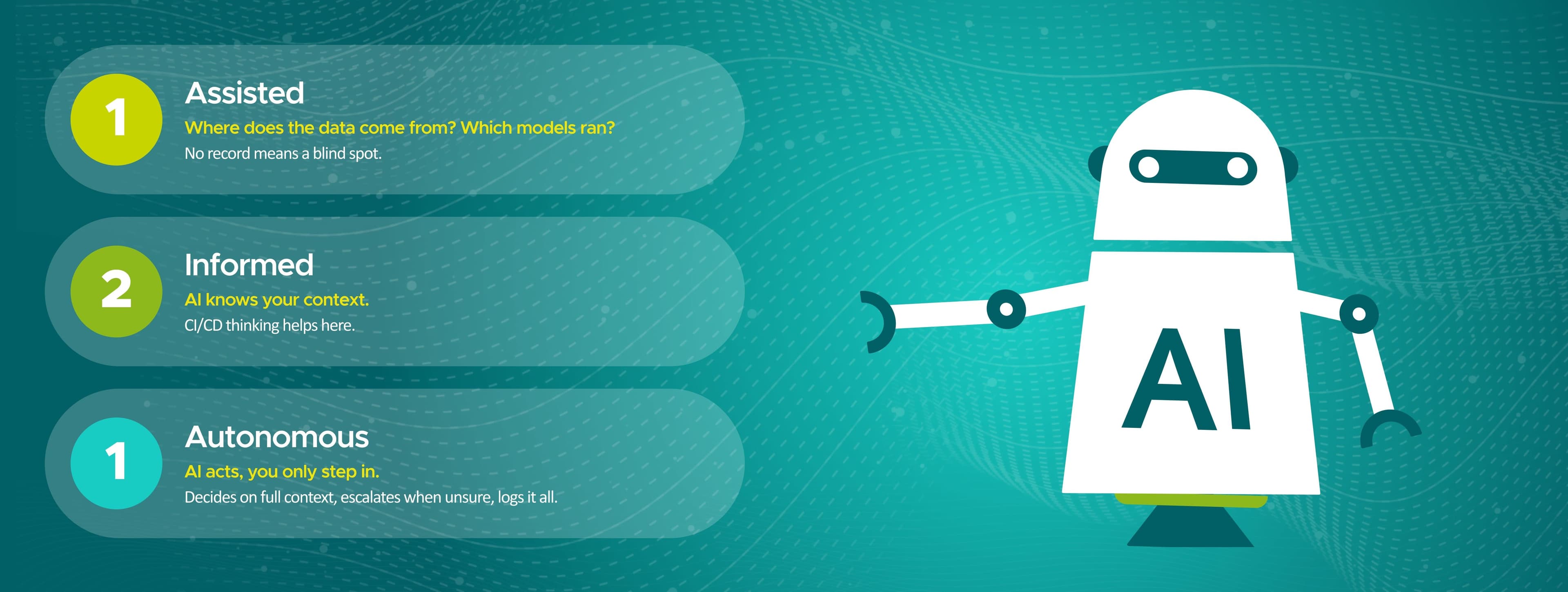
Zone 1 – Assisted: AI provides support; humans make all the decisions
This is the current state of affairs for most companies.
AI generates drafts, suggestions, and summaries. A human reviews every piece of output. Supervision is not optional – it’s mandatory. The system cannot distinguish between a good and a bad suggestion because it lacks the context needed to make that distinction.
“Assisted” is not a failure. It is a legitimate starting point. But it is not a goal.
Zone 2 – Informed: AI has access to structured business context
This is where true productivity begins.
An “Informed” system has access to internal data: product data, categorization rules, customer segments, and current documents. It can answer questions that go beyond general knowledge. Trust grows because the outputs are transparent.
The path from Zone 1 to Zone 2 does not lie in a better model. It lies in the Context Layer – the layer that structures corporate data, keeps it up to date, and makes it accessible to AI systems.
Zone 3 – Autonomous: AI acts and escalates only in cases of genuine uncertainty
This is the goal that many describe but few have achieved.
An autonomous system makes decisions based on full access to context. It escalates when it is uncertain. It logs what it has decided and why. A human intervenes only when the system requires it.
Zone 3 requires Zone 2. Without full, reliable access to context, there is no productive autonomy. There are only autonomous errors.
Architectural Requirements for Zone 3 – Context Layer
The leap to Zones 2 and 3 hinges on a layer that sits between AI and the enterprise: the Context Layer. It ensures that, at runtime, a model receives exactly the context it needs for a task – regulated, up-to-date, and traceable.
The difference from what most people use today is significant. Many teams work with manually maintained rules files or system prompts. Someone writes down what the model is supposed to know. Someone updates this file when something changes. Someone notices when it becomes outdated.
This approach doesn’t scale, and it explains why teams eventually stop trusting the rules files and start checking every output again.
A resilient context layer is created through two complementary approaches:
Direct Access via MCP (Model Context Protocol)
MCP is an open standard through which an AI system communicates with real-world systems – PIM, ERP, CRM, DAM – in real time and on a role-based basis. The AI retrieves product data, pricing rules, or documents exactly when it needs them, directly from the source. There is no copy that can become outdated; changes in the source system take effect immediately. For production use, this is currently the most direct approach because AI not only reads but can also take targeted action using defined tools.
Curated knowledge via Enterprise RAG
Where knowledge exists in unstructured form – documents, manuals, minutes – Retrieval-Augmented Generation (RAG) complements direct access: Relevant passages are retrieved from a knowledge base at runtime and embedded in the response. RAG is thus a useful prerequisite for cases lacking a clean system interface – not the goal in itself.
What matters is not the individual technology, but that both contribute to the same regulated context layer. It is this layer that makes Zones 2 and 3 possible – not a better model.
Silos as a structural context problem – My assessment
I’ll say this outright because I believe it’s underestimated: Most context problems in companies are organizational problems.
What many companies do wrong is organize themselves into silos. Each department optimizes its own subset of data. No single team takes holistic responsibility for data quality. Knowledge remains in people’s heads instead of in the system. This isn’t a criticism. It’s a structural pattern I see in almost every large company. And it directly creates the context problem that holds AI systems back.
An AI system that accesses a well-maintained, complete product database will produce different results than one that relies on three conflicting Excel exports from different teams. The difference does not lie in the model. It lies in the data quality – which the team behind it is responsible for – or not.
What matters are interdisciplinary teams with clear responsibility for data quality and system boundaries. Teams that jointly decide which system is the “source of truth.” Teams that maintain the context that AI needs.
Recent study data confirms this assessment. According to a [Roland Berger study from 2026](https://www.techzeitgeist.de/ki-transformation-2026 -business-model-leadership-integration-control-reg/), which surveyed 472 executives, 49% cite a lack of AI skills as the biggest barrier to AI transformation, while 37% consider organizational structure and processes to be unsuitable. Technology isn’t the top priority. The foundation is the top priority.
What this means in practice – A brief overview
If you want to determine where your team stands on the maturity model, these three questions can help.
- Who reviews AI outputs in your team? If the answer is “someone always does,” you’re in Zone 1.
- Does AI have access to real, up-to-date company data? If the answer is “no” or “partially in a demo setup,” you don’t yet have a functioning context layer.
- Are there AI processes in your company that run in production without a manual review loop? If yes, then Zone 2 is up and running. If no, then Zone 3 is still one architectural decision away.
Most teams I speak with are in Zone 1 and are slowly moving toward Zone 2. This doesn’t mean they’re falling behind – it’s simply the current state of the market. The key question is whether the path to Zone 3 is viewed as an architectural task or as a search for the next, better model.
What’s behind communicode
At communicode, we’ve been working for years on systems that structure product data, ensure its consistency, and make it accessible to machines. This is the core of PXM and the foundation for a robust context layer.
As part of AI integration projects, we combine both: controlled access to real enterprise data – directly via MCP, where systems are connected, supplemented by Enterprise RAG for unstructured knowledge – with the agent architecture that can utilize this context. The result is systems that work with the company’s knowledge rather than simply providing generic answers.
For us, Zone 3 is not just a promise. It is an architectural project that can be planned with the right foundation.

Thomas Kopatz
As Director Development and electrical engineering graduate, technology has always been the passion of the co-founder of communicode. Responsible for software development and an expert on the latest software and cloud trends, Thomas is a mediator between technology and business. His focus is on the conception of modern, scalable software solutions and the creation of the necessary sustainable software processes.