Agentic AI doesn't start with AI – it starts with effective digital transformation
For many years, we have been helping companies build complex digital platforms. We structure product data, integrate systems, develop e-commerce solutions, create modern software architectures, and support organizational change.
Long before terms like “Agentic AI” or “AI agents” even existed, we laid the groundwork on which these technologies are built today. After all, autonomous AI agents do not emerge in a vacuum; they require high-quality data, interconnected systems, clear processes, and an organization that actively shapes change.
That is precisely why we talk about Agentic Readiness today.

The next stage of AI development doe not start with the model
Over the past two years, many companies have gained initial experience with generative AI. Whether it’s creating text, researching information, generating code, or developing marketing content – conversational AI is already an integral part of daily work in many areas.
But development continues. The next generation of AI systems not only answers questions but can also plan tasks independently, combine information from various sources, and execute actions across system boundaries. These so-called AI agents (Agentic AI) will bring about lasting changes to many business processes in the coming years.
The crucial question is therefore no longer:
“Which AI model should we use?”,
but rather:
“Is our company even ready for Agentic AI?”
This is precisely where the concept of Agentic Readiness comes into play.
What does “Agentic Readiness” mean?
Agentic Readiness describes a company’s level of maturity for the productive deployment of autonomous AI agents. It refers to the interplay of data, organization, and system infrastructure that determines whether an AI agent actually creates added value in day-to-day operations or remains merely a pilot project.
An AI agent must understand corporate knowledge, access various systems, evaluate information, make decisions, and initiate processes. Each of these capabilities depends on prerequisites that many companies are only now establishing.
Three dimensions determine how well a company is prepared and transform an AI application into a true digital employee:
- Data & Knowledge
- Strategy & Organization
- Technology & Delivery
Why ChatGPT alone is not enough
A language model answers questions. An AI agent takes action. It plans sub-steps, combines information from multiple sources, and carries out actions across system boundaries. This autonomy fundamentally changes the requirements. The crucial question, therefore, is no longer which model is used, but whether the company has laid the groundwork for an agent to operate reliably.
The three dimensions of Agentic Readiness
Dimension 1: Data & Knowledge – The fuel for AI agents
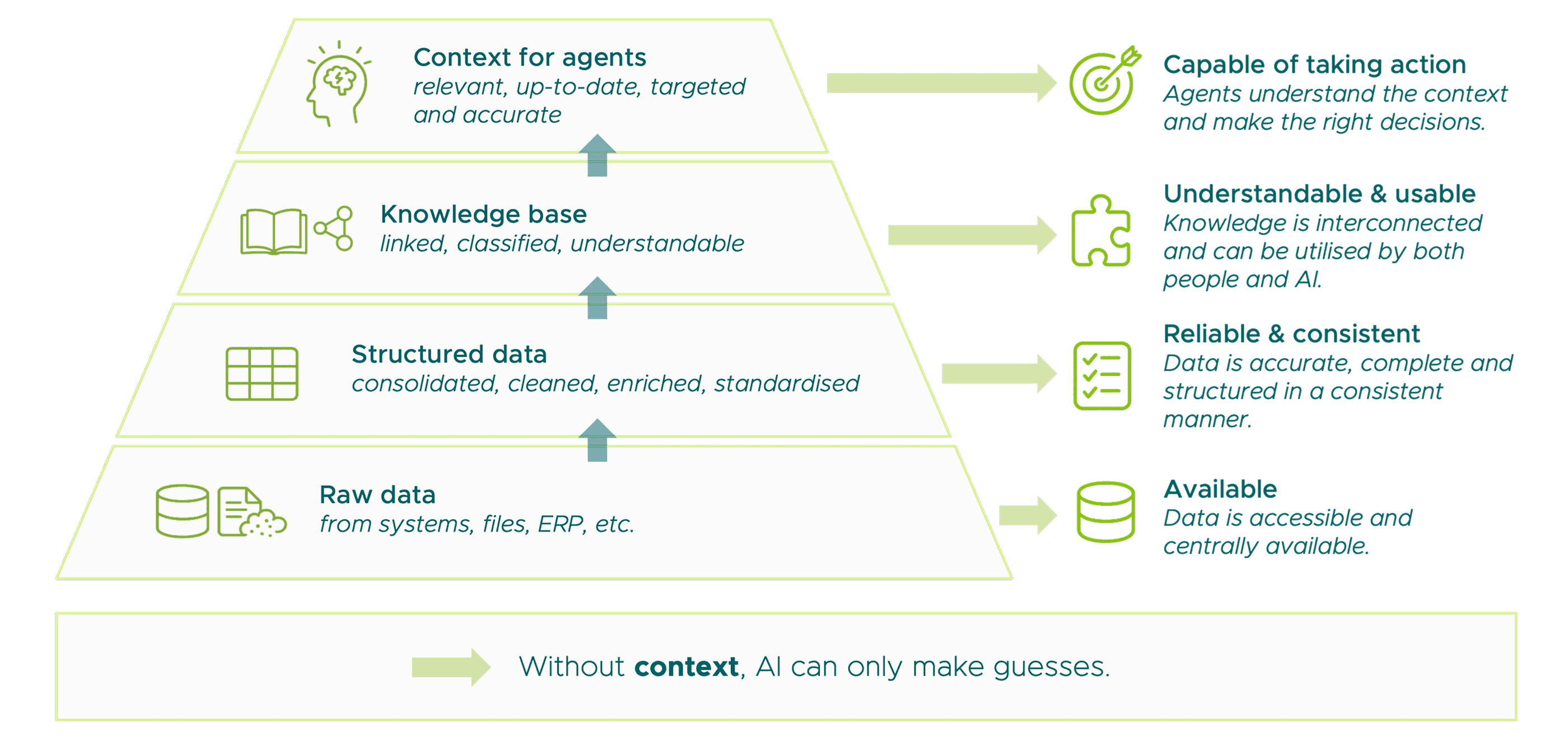
The quality of an AI agent depends directly on the quality of its context. In our projects, we encounter the same situation time and again. Companies already have valuable information – scattered across ERP, PIM, DAM, CRM, commerce platforms, or custom line-of-business applications.
The challenge rarely lies in acquiring data.
The real challenge is making that data available, consistent, and understandable across system boundaries.
It is precisely this work that forms the foundation of Agentic AI today. Without context, AI can only operate on assumptions.
Dimension 2: Strategy & Organization – People remain at the center
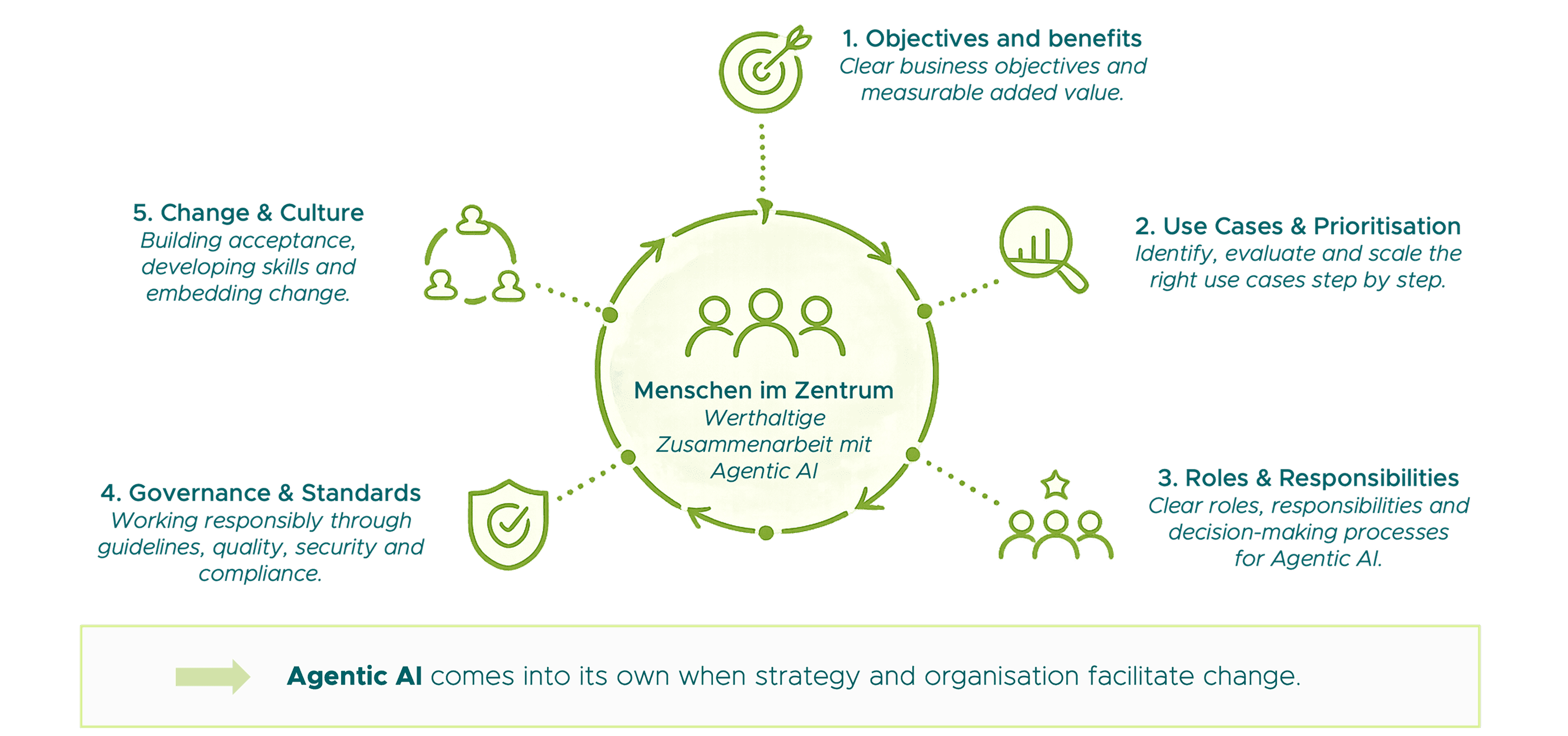
Agentic AI is transforming work practices, roles, and responsibilities. Anyone delegating tasks to agents must clarify which business objectives are being pursued, which processes are actually suitable, who bears responsibility, and what the governance framework looks like. The question of how employees can support this transformation is also relevant here.
Many AI initiatives do not fail for technology reasons, but due to a lack of strategic integration. Successful companies therefore do not start with as many use cases as possible at once, but rather with clearly prioritized use cases and defined responsibilities. Technology alone is not enough to achieve this.
Agentic AI delivers its added value where technology and organization are developed together.
Dimension 3: Technology & Delivery – Intelligently connecting systems
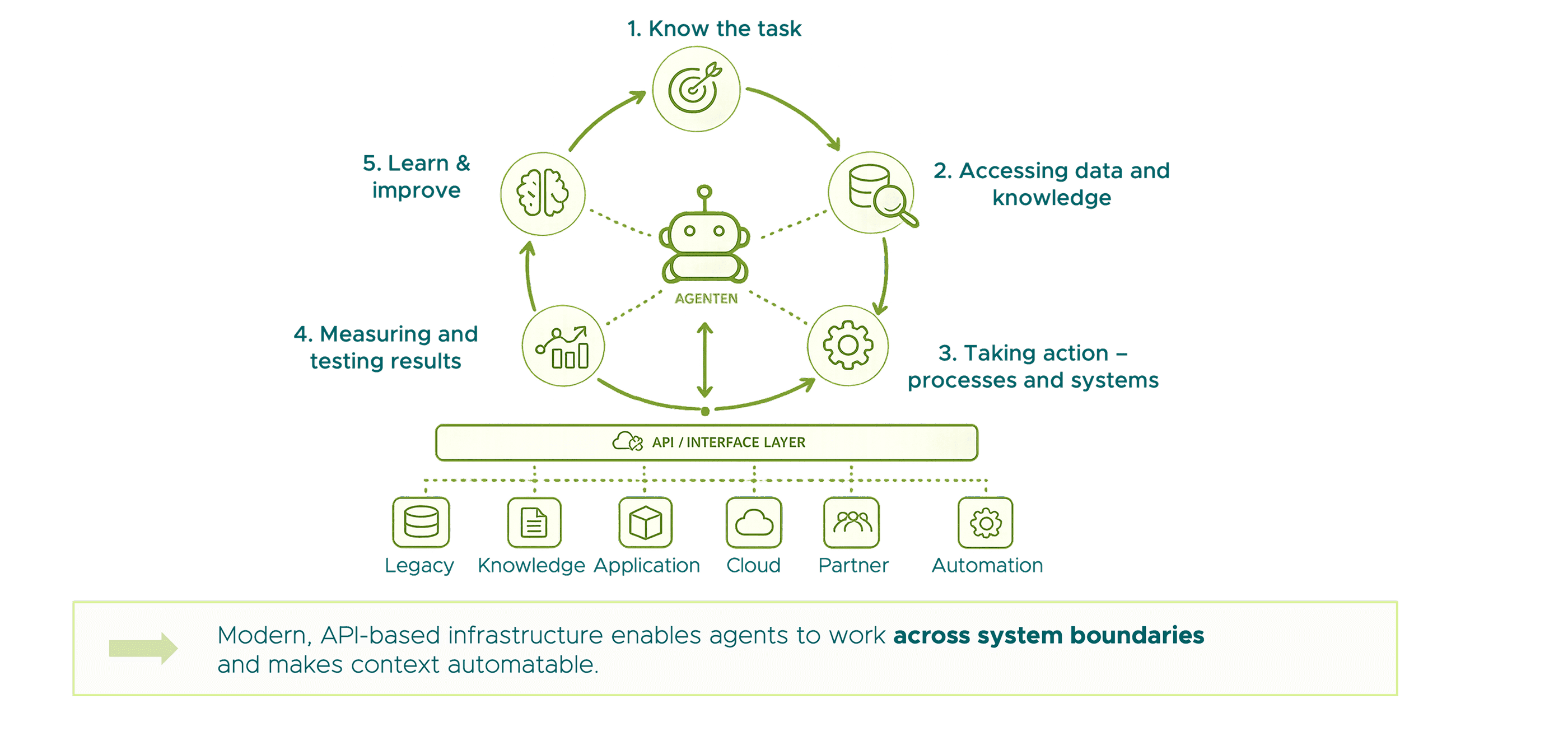
For AI agents to work productively, they need access to the systems where corporate knowledge is stored: ERP, PIM, DAM, CRM, online stores, DMS, cloud applications, partner platforms, etc.
Modern architectures and open interfaces enable agents to retrieve information across systems and derive concrete actions from it, such as researching content, evaluating images, supplementing data, assigning products, initiating processes, or documenting results.
Developing such integration architectures has been part of our core business for years. What used to be the exchange of data between ERP, PIM, DAM, or commerce platforms has now become the workspace of intelligent agents.
The Model Context Protocol (MCP) plays an increasingly important role here because it allows agents standardized access to external systems. Ultimately, success depends less on the individual AI model than on the ability to leverage knowledge across system boundaries.
Practical example: From image search to campaign recommendations
We’ve demonstrated how this interaction works in practice using our own prototype.
A marketing employee formulates a simple request: “Find suitable images for a summer campaign.”
An AI agent then carries out several steps independently:
- It understands the request.
- It accesses corporate knowledge.
- Various systems are connected via an MCP server – including a Digital Asset Management (DAM) system.
- A vision AI analyzes the images found.
- The agent evaluates which assets are suitable for the campaign.
- Finally, it provides a reasoned recommendation instead of a simple list of results.
The real innovation here does not lie in the image analysis itself. It arises from the interplay of knowledge, context, and an infrastructure that intelligently orchestrates various systems.
Common obstacles
In discussions with companies, we repeatedly encounter similar challenges:
- Data is stored in isolated systems.
- Knowledge is not available in a structured format.
- There is no common AI strategy.
- Processes are not sufficiently documented.
- Pilot projects remain isolated solutions.
The result: While AI delivers impressive individual results, it cannot be sustainably integrated into the value chain.
Agentic Readiness helps systematically close these gaps.
Conclusion: For us, Agentic AI is the logical next step in digital transformation
We do not believe that Agentic AI will replace traditional enterprise software. On the contrary, the value of existing systems is increasing. That is precisely where the knowledge lies that AI agents will access in the future.
Therefore, we do not view Agentic Readiness as a new project separate from digital transformation. It is the logical next step in that journey.
For many years, we have been helping companies to
- make data usable,
- integrate complex system landscapes,
- develop modern software solutions,
- digitize business processes,
- and support organizational change.
Today, a new capability is emerging: enterprise software is becoming intelligent. Agents access knowledge, understand contexts, and support people in their daily work.
We are convinced: The most successful AI projects of the coming years will not emerge where the latest models are deployed, but where companies are already investing in data, integration, software, and organization today.
And this is precisely where we have been supporting our customers for many years. We lay the very foundations on which Agentic AI can build today.


Michael Ochtrop
Michael develops technical and procedural concepts for the introduction of software solutions in organizations. From communicode's 20-year company history, he is familiar with almost every scenario in the data management context. His concern in the customer project is to make everyone involved convinced users and thus make the company more successful. After all, software only leads to improvements in conjunction with people and processes.